Bob Hope Still Owes Russia $1200
by Joel Van Valin
Bob Hope had his last laugh this year, ambling off the stage of an almost mythical life that spanned a century, most of it spent in comedy. And much of it also spent going from one place to another, in planes, boats, taxis, even dog sleds. My generation remembers Bob Hope mostly as a stand-up relic who loved to golf and occasionally did specials on aircraft carriers with bodacious sidekicks like Brook Shields. But he was the Mike Myers of his day, pioneering a new brand of conversational comedy and deadpan timing. And in the `40s and `50s, the guy was literally everywhere: in the movies, on the radio, and especially live, doing countless USO shows for our troops stationed abroad, many of them over Christmas. He was in print too, writing half a dozen books, including I Owe Russia $1200, a memoir of his visit to Russia circa 1960.
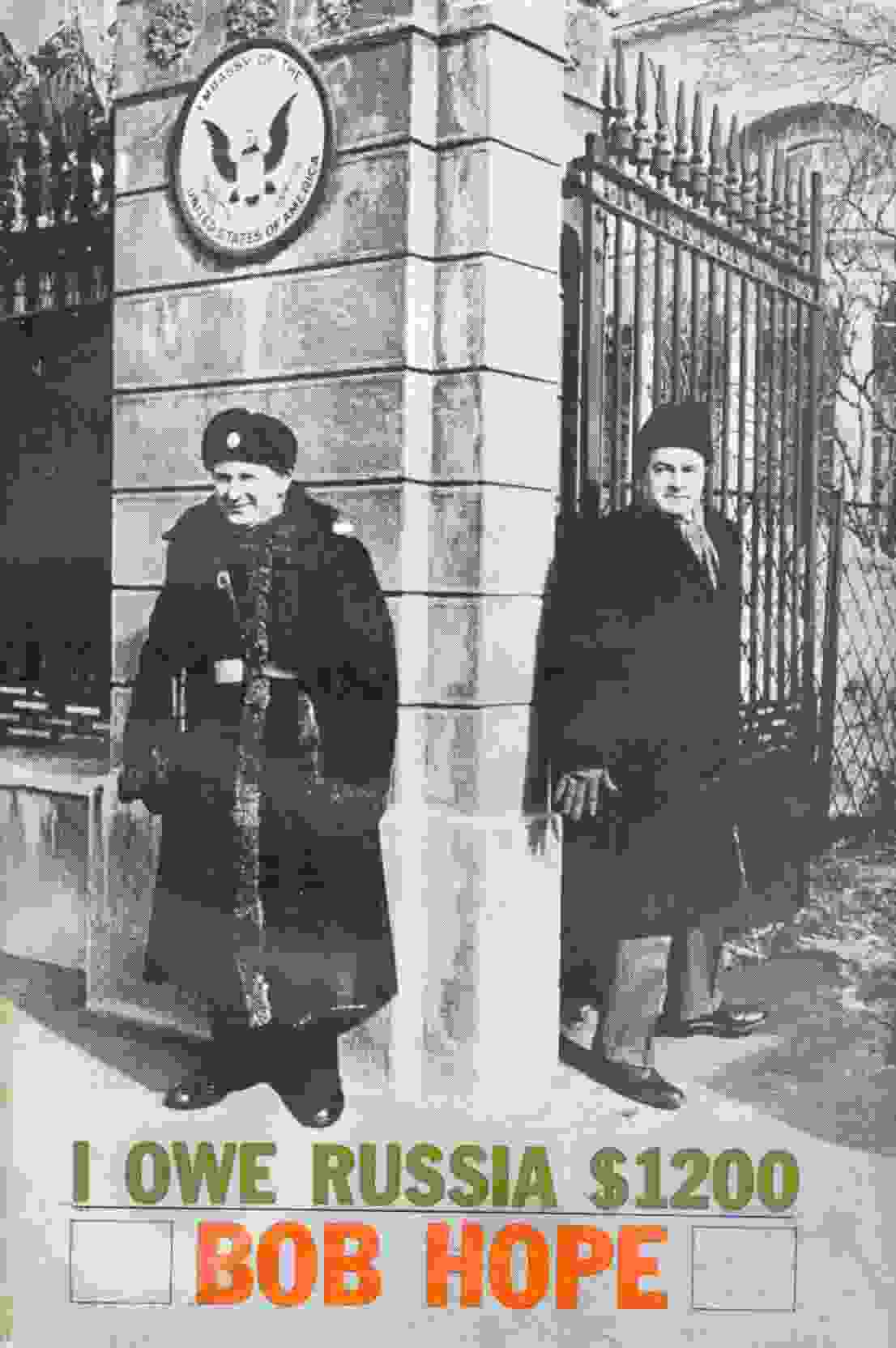 Actually, I Owe Russia is a fan book more than anything. After opening with a story about how he and Frank Sinatra triggered an international incident during a luncheon for Khrushchev (by suggesting he visit Disneyland) Hope runs blithely on for 170 odd pages about how he made a movie with Bing Crosby in England, how he went a million dollars over budget making another film in France, and how he skip-jumped from Korea to Greenland to Guantánamo Bay doing tours for the troops. He writes very little about his personal life (his wife is only mentioned once, and their four children barely at all) while giving us pages of tidbits about Hollywood stars who have since dimmed to obscurity (Hedda Hopper, Anita Ekberg, Jerry Colonna). Even so, the book is engaging, mostly because of the travel stories we find scattered here and there. For example, the time the airplane was filled with the wrong type of fuel--it could have blown up in midair, but the pilot had the fuel checked before takeoff because he didn't think it smelled right. Or the time Jayne Mansfield thought she had lost a diamond earring in the snow in Thule, Greenland, and had a thousand GIs searching with flashlights in a twenty below gale (she actually hadn't lost the earring--she'd put both of them on her right ear). Then of course there are the one-liners. A jet-lagged Hope playing golf in Morocco:
Before we finished playing. I was so beat I could hardly climb out of my divots. To give you an idea of how exhausted I was, I put down my right score.
A golf course in the sandy terrain of Morocco is a rarity. The fairways were all sand, and every so often there was a little patch of grass--that was a trap.
And of course, there's the Russia trip itself, tucked away in the last forty pages of the book. While in London, Hope happened to see a performance of the Ukraine State Dance Ensemble at Albert Hall, and was impressed. "Here was an entirely new facet of entertainment, new faces, new music, new acts." He was doing television specials every few months, and decided he just had to do one in Moscow, even if it meant special permissions and wrangling over visas. "If there was a dent in the Iron Curtain, I was going to find it."
He arrived in March with a small entourage that included writers, press agents and cameramen, and from the start it was an adventure out of one of his own "Road" films. They were assigned to the elite Ukraine Hotel, where "the lobby was swinging with hundreds of pajama-clad Uzbeks and Mongolians," leaders and agriculturalists from the provinces.
After I finished unpacking, we played the popular Russian tourist game, "Search for the hidden microphone." The TV set with all its wires was a very suspect place and we searched it thoroughly without finding anything.
Back in the States a reporter asked if they had television in Russia, and without thinking, I replied, "Yes. But it watches you."
The Communists didn't seem to get Hope's jokes, and they weren't exactly cooperative. After some sight-seeing at Red Square, he returned to the hotel to find his suitcase had been opened an his monologues spread across the bed. When his cameramen tried to take pictures of Russian nightlife they were stopped by security. And they couldn't book a theater for the show, so had to put it on at the American embassy. Then there was the missing film. Russian cameras were supposedly incompatible with American film, and so they had to use Russian film and develop it there. A certain Comrade Davydov, head of the Soviet Export Film, told Hope he had to pay a fee for the film processing. "We thrashed verbally for several rounds and when he finally took his knee out of my chest, I owed Russia twelve hundred dollars. That was three years ago, and I still do. Two of the film clips I ordered never showed up." Hence the title.
Though he was born in England, the son of a stonemason, Hope was in many ways the quintessential American: jovial, enterprising, patriotic. Behind enemy lines in the most frigid era of the Cold War, it shouldn't be surprising that his descriptions of Moscow have the quiet tension of a tight-rope walker. In his gentle ribbing about life in everyday Russia, he seems to be trying to reassure his readers that yes indeedy, the USA was still number one, regardless of Sputnik orbiting overhead every 96 minutes. Yet like all comedians, he was a astute observer of humanity, and the scenes he witnessed in Russia obviously touched him.
For five days and nights I have stared and walked and wondered. It's a strange city. I missed the street signs, the hubbub of traffic, the colorful clothing, the billboards, and the neon gleaming in the night.
Yet, there is much that is the same: people trying to make a living, people trying to keep their families together. And kids, wonderful kids with great faces ...
Right now the world is busy building a bomb for every letter in the alphabet. That cannot be the answer. But there must be one.
The answer came thirty years later with Boris Yeltsin, and Hope was lucky enough to still be alive when it happened. As for the missing film and the $1200--heck, I volunteer to go to Russia to sort it all out. The TV can watch me all it wants.
Copyright 2003 by Joel Van Valin. All rights reserved.
Joel Van Valin is the publisher of Whistling Shade and the author of the fantasy novel The Flower of Clear Burning.