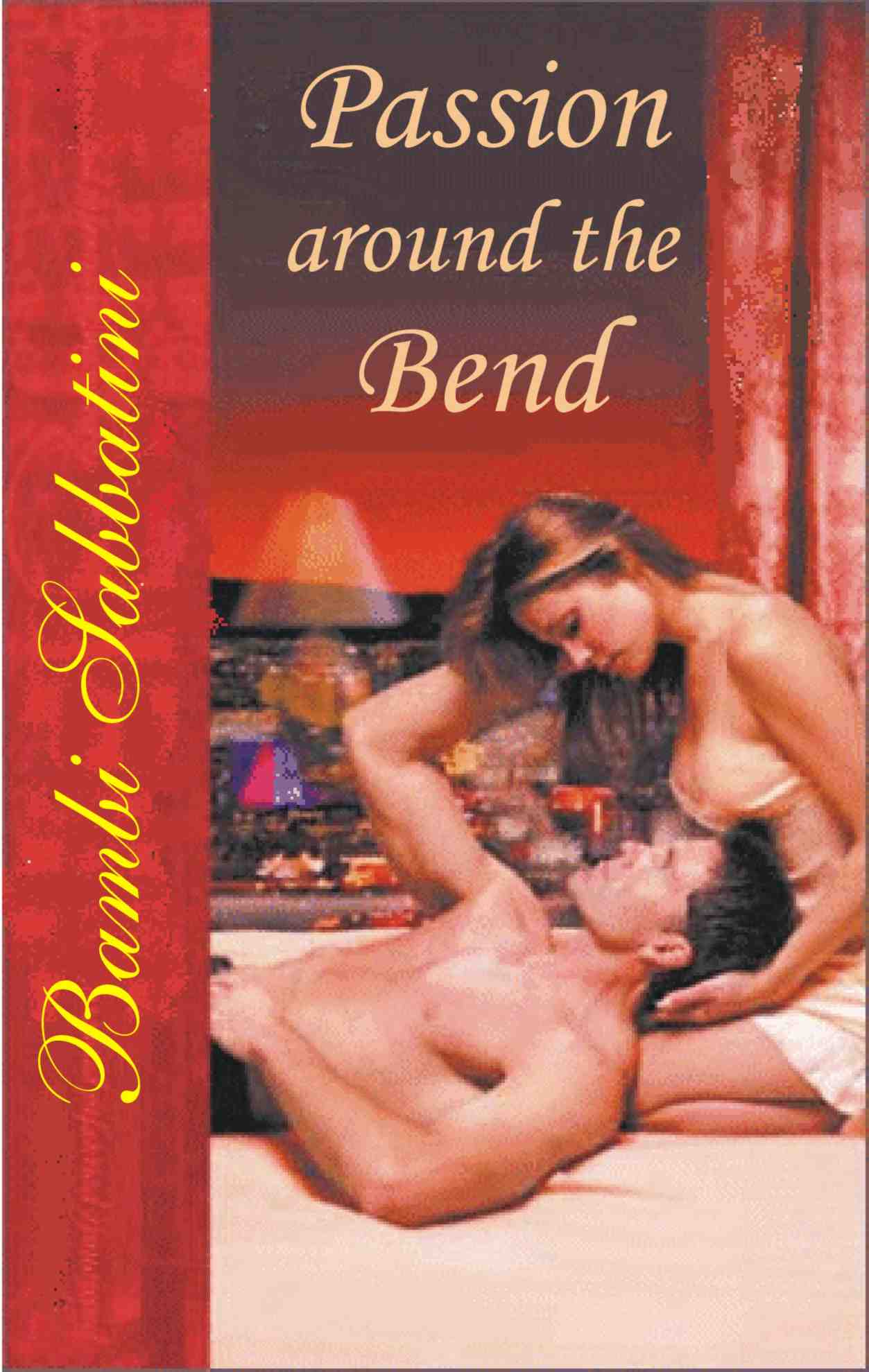
"Welcome to Bambi Sabatini, Inc.," said the middle-aged man in the business suit. The nervous young woman he addressed rose from her chair in the personnel office and shook his hand tentatively. "I'm Bob Hyde, one of the novel managers. If you'll follow me, Ms., uh, ummawho..."
"Ms. Hutchins, I'll take you back so you can see our place in operation and we can talk. By the way I'm Bob. May I call you, er, emmawho..."
They passed through a door into a large area filled with gray cubicles. Each cubicle came equipped with desk, computer, phone, and human occupant. Ms. Hutchins was sure the cubicles were fire-retardant and noise-reducing, and that the human occupants were team players. In an open area a large polished table supported the elbows, note pads, and coffee cups of six people in heated conference.
"This is where we grind out at least three new Bambi Sabatini novels a year, Barbara," said Mr. Hyde as the two slowly walked on. "Right now Jim Slaughter's team is polishing up Bambi's thirty-second work, Passion Around the Bend, for release this spring. That was Helen Wisdom's team at the conference table, getting ideas flowing for Bambi's thirty-fourth effort, tentatively called Love at All Costs. That one'll hit the bookstore shelves next year. My team's right in the middle of Bambi's opus thirty-three, Desire Under the Elms, for publication in the fall. We're sort of in a race to stay ahead of Helen's team, which is notoriously fast. If her team passes us up, then hers will be Bambi's thirty-third and ours her thirty-fourth. But it's a friendly competition and we wish her well."
"I'm glad it's friendly," said Ms. Hutchins.
"Oh yes," said Mr. Hyde. "Everyone at Bambi Sabatini gets along famously. We work in three teams of six novelists each, including novel managers like Jim, Helen and myself who are also novelists, and each team must complete a book every six months. Some on the teams are strictly idea people, some do the actual writing, but we call everyone a novelist. We think that's good for morale. We publish two novels a year and try to hold one in reserve, though sometimes we only end up with two good ones. Think about that, Barbara. Could you finish three books a year all by yourself?"
"No, I don't think I could," said Ms. Hutchins. "I wondered how one author could produce so many works."
"Now you know," said Mr. Hyde. "Impressive, isn't it?" He showed Ms. Hutchins a friendly smile as they continued to walk. "There's a story that Bambi Sabatini herself once sent in a novel she had written to be published. But we rejected it because it didn't sound like her."
Ms. Hutchins returned his smile. "Is there a Bambi Sabatini?" she asked.
"I'm not certain anyone here really knows. The company owner Otis Crutchfield came up with that name twenty years ago. Possibly it's someone he knows. But I've been here five years and never met Bambi Sabatini, and as far as I know the company has only published collaborative novels under that name. Her bio on the jackets is of course a fiction, and the perpetually young and intellectual-looking woman whose picture is on them is a model under contract. Here we are. Have a seat."
A dying rubber plant in a plastic pot sat atop a gray metal filing cabinet in Mr. Hyde's cubicle. Mr. Hyde sat at his small desk, and Ms. Hutchins sat in the form-fitting but hard chair that faced him. A stack of typewritten pages lay before him on the desk, and he placed a hand on it.
"I have the novel you sent us as part of your application, and it's quite interesting," he said.
"I wasn't sure what you were looking for," said Ms. Hutchins, "but it's my first complete novel, so I sent it in."
"Have you submitted it to publishers?"
"It's been rejected 25 times."
"Yes, it's a competitive business. Well, your manuscript shows me you have good writing ability, but of course you'd need coaching in Bambi Sabatini's style. Have you read any of Bambi's books?"
"I'm afraid I haven't. I did take one out of the library, but I've only just begun it. Of course I've seen them in the stores, and lots of other people reading them."
"The Bambi style is distinctive, but not overly difficult to learn. Your Kierkegaard in Love seems to an historical romance based on actual people and events, and I want to point out to you some of the changes that Bambi Sabatini would need to make in the book."
"Are you saying Kiekegaard in Love may be published as a Bambi Sabatini novel?"
"No, I'm afraid not. Our readers aren't conversant with Danish philosophers who have nonexistent sex lives and squeaky voices, not to mention spinal curvature and religious crises. Did you major in philosophy in college?"
"Literature, actually. With a few courses on the existentialists."
"Well there are all kinds of backgrounds here. I went to work instead of college and sold for a greeting card company. Gradually I advanced to writing the greeting verses themselves, and with luck and hard work I made it to Bambi Sabatini. I'm one of the few men here, and if you'd told me five years ago I'd be writing romances for a living, I'd have told you to have your head examined. But here I am."
"I'm a bit surprised to be here myself. I work for a newspaper now, as a minor reporter."
"Newspaper writing is also quite different from what we do here. I'd like to show you now what you'll be responsible for writing if you become part of a Bambi Sabatini novel-writing team."
Mr. Hyde lifted a page from the top of her manuscript and handed it to her. The page had red brackets drawn on it.
"Read me the short scene I've marked out in your novel, where Mr. Kierkegaard and Ms. Olsen meet outside church one drab Sunday morning."
Ms. Hutchins took the page, swallowed nervously, and read aloud: "Soren turned his eyes away from hers. Briefly they took in her delicate ankles before they found the street of cold stone. Then he said in his dear parrot squawk, 'Our engagement is Heaven calling, Heaven calling. But I am not yet ready to heed the call. I'm cursed.' Regine looked at his stove-pipe trousers, the object of so much derision in The Corsair magazine, his high hat that he now swept off to reveal his startling French pompadour like a rooster's comb, and his tight waistcoat that shielded his poor thin back. 'Soren,' she said, her voice in velvet contrast to his screech, 'I'm concerned about this life, too. This earthly existence calls me as much as Heaven does, though I'm ashamed to admit it to you. For me, Heaven must wait.' She wanted him to take her hand, at least to gaze at her now, but he only went on staring at the dirty snow in the street. His expression indicated her words had wounded him."
"OK," said Mr. Hyde, handing Ms. Hutchins another typed page. "Now read this. It's the same scene, more or less, as Bambi would write it. I wrote it myself."
Ms. Hutchins put her page down on the desk and took Mr. Hyde's. She read to him: "'Regine,' said Soren as the two stood on the church steps, ready to enter for Sunday morning service. 'You're the most desirable woman in Christendom.' Regine, the envy of the other Copenhagen girls for her lustrous mane of blonde hair and opalescent eyes and trim ankles, took his hand in eagerness, wishing to hold it against her breast even here on the church steps! Fondly she recalled last night in her boudoir as Soren had removed his form-fitting waistcoat and shirt to reveal his manly chest that tapered like a V to his famous snug trousers. His tousled red locks and copper chest hairs had glinted in the moonlight as he approached her bedside and she nearly swooned as the Corsair magazine's cutest male model crawled under the sheets beside her. 'Baby, you're going to like this,' he had whispered soothingly to her as he began to gently caress her bare alabaster shoulders. 'Oh Soren,' she breathed in the present again. 'Let's skip holy communion this morning.'"
"I see you're smiling," said Mr. Hyde when Ms. Hutchins had finished. "I guess you think it's crap. Well, maybe you'll change your tune when you see how difficult it is to do." For all that, he didn't seem offended.
"I'm sorry," she said, twisting in her chair. "Would you excuse me a minute? Which way is the ladies'?"
She went in the direction he was happy to show her, the smile frozen on her face. In the restroom she inhaled deeply while studying herself in the mirror. No one else was inside and so she permitted herself to giggle, a little at first, and then uncontrollably. "Is my present job on the paper so bad?" she asked her beaming reflection, when she had calmed a bit. "OK, Ted's a jerk for never giving me a major story. And writing about every museum opening and flower show in town is a drag. But would writing about 'pulsing manhood' and 'quaking breasts' be any improvement?"
The door opened just then and a short, almost elderly woman entered. Her mostly white hair was flattened around her head as if she had recently taken off a tight-fitting cap. Seeing Ms. Hutchins, the woman paused. "Did you have your interview yet?" she asked.
"It's in progress," replied Ms. Hutchins, looking in the glass to see what her face revealed. "At least, I left it that way."
"The old pornographer. He sits back there looking at nudes on his computer all day, you know. He didn't upset you, did he? You look upset." She fished a pack of cigarettes out of her purse.
"Not at all. I'm fine. Are you one of the novelists?"
"I've sold my soul, yes." She lit up and exhaled smoke. "Ever read Moby Dick? Of course you have. Remember the scene where Elijah warns Ishmael not to ship on the Pequod under Captain Ahab? Well I'm warning you, dear, in the same terms. Don't ship on the Bambi Sabatini under Hyde or any of these demented captains. Trash to sell is all they care about here. You'll waste your life piling up trash here, just as I've wasted mine. Been here 25 years with no escape in sight. That's a lot of trash to climb over."
"I was assuming I could write my own things on my own time."
"I made that assumption too, long ago, but I've learned there is no 'my own time.' There's only Bambi time. When you get done here, at the pace they expect the rubbish to flow out of you, you'll be too exhausted to write a haiku. If you do write one, it'll sound like Bambi wrote it. I'm sure you have talent, and I'm sure you care about it, so run for your life."
The woman then disappeared into a stall. Before she did, Ms. Hutchins noticed that she pulled a paperback from her purse. It was Melville's Billy Budd. Ah, thought Ms. Hutchins, the Beautiful Sailor. Literature, real literature, was evidently confined to the bathroom here. With smoking and other sins.
Ms. Hutchins came out of the ladies' room and, with only the briefest pause, made her way outside the building to her car.