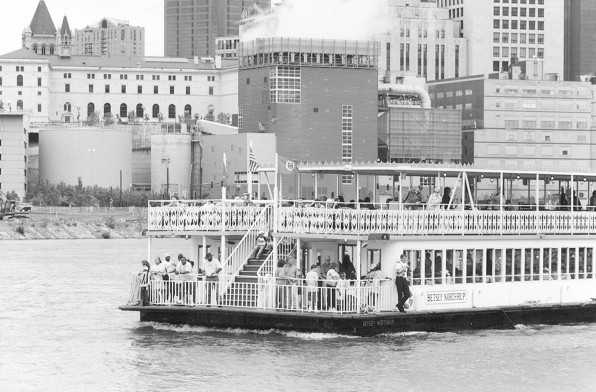
The paddleboats were moored against a network of aluminum piers floating near the banks of the river, harnessed with lines made taut by the river pushing the boats unceasingly downstream. They stood backlit against the grey sky, their crowned chimneys like the towers of a small medieval castle extending from the low bulk of their decking and hulls. There were three boats, just as Audrey had said in her last email. There was a small paddleboat used for private excursions and one called the Jubilee that the packet company used to host swing dances, mostly for senior citizens, Audrey said, and a third boat called the Imperial. That one's ours, she'd written. The Imperial: the perfect boat for trysts and privacy, where all the young couples go for romance and adventure. The perfect first date. They'd never met except for emails passed back and forth, and he'd only seen two pictures: one posted on her internet personals ad and the one she sent later when he complained that in the first she'd covered half her face with a sweep of auburn hair.
Still she was unmistakable in person, a modern girl with an old-timey name, bold and confident in a nylon windbreaker and white slacks, her hair in casual pigtails and bangs. This was a girl not afraid to use the word blowjob in her emails to a man she hadn't met, or to even meet that man un-chaperoned on a boat fifty miles from home. For a moment Bill felt something like fear. Then he felt guilt and anticipatory regret, and wanted to turn around and abandon Audrey here, then send her a note explaining the whole thing. He'd tell her about his girlfriend, how maybe things weren't going so well right now but that starting something with another woman wasn't the answer. He should go back home, talk to his girlfriend and forget all this foolishness. There was leftover Chinese at home, they could have a snack, go to a movie, maybe have a little sex. Do some normal couple things.
All these thoughts were in his mind as he crossed the final twenty feet and said hi to Audrey. She smiled, said his name, then he said hers. They shook hands like they were about to play mixed doubles for the first time. Here we are, said Audrey.
We sure are, said Bill. Should we get tickets?
Bill cast an eye on the slate grey clouds crowding low over their head. Said, Looks like it might rain.
Oh, I don't know. Maybe we'll have a wet t-shirt contest. She ducked and giggled and looked at him apologetically. In his surprise he was unable to say anything or think of any response aside from mumbling about how a little water never hurt anything. And then Audrey said, For crying out loud, let's get a good look at you then. She stepped back on her heels to gave him a big sweeping glance at his leather shoes, his brown canvas pants, the long-sleeve golf shirt with zippered front and jersey sleeves. She smiled a gap-toothed smile and said, You're a strapping lad that's for sure.
But what about you? he said, and at the faux-shocked look on Audrey's face he said Fair's fair; what's under that windbreaker? And so she unzipped it and threw it to the ground and lifted one hand in the air like a magician's assistant to stand there in a t-shirt silk-screened with the word Cuddly. She was thick but sexy-thick with full breasts and a neatly tucked waist and Bill laughed and clapped a few times as she pulled her hand down and picked up the jacket and put it back on. That's it for the free show, she said. You gotta earn the next peek.
He put a hand on her waist and led her to the ticket window. She was soft and warm under his hand, and he thought how his girlfriend was all sharp angles, cold knees and elbows poking at him in the night. Not that he was unhappy with her, or bored. They weren't even fighting, really, though there'd always been an antagonism to their relationship, a tension that hummed in the background noise of their life like an electrical device about to short-circuit. He'd grown so used to the tension he didn't even notice it until one evening the hum went silent as he was casually, almost accidentally, browsing the personals ads on the internet.
Bill and Audrey bought tickets for their cruise, then stood amidst a cluster of people waiting for the gates to open. There were families with children, a few other couples, and a handful of senior citizens awaiting boarding for the Swing Dance cruise on the Jubilee. Old men in nylon jackets and pastel pants stood staring, chins raised with an ancient proud defiance at the murky brown river and the thickly forested banks on the opposite side. What they were defying was unclear but maybe it was their own age, the history of their lives to this point which only the presence of a great flowing river, that hoary old metaphor of passing time made fully corporeal, can conjure up. Their women, with hair like spun cotton and oversized glasses, stood chattering amongst themselves about grandchildren and the misdeeds of neighbors long past. It was seventy-two degrees and they were in pantsuits and driving coats, layered up like it was still late winter.
What're you thinking about? Audrey said.
Bill wasn't sure. Not about her or his girlfriend or anything that he could put into words, he knew that. He was thinking about the old people drifting, about where he might find himself in fifty years. The nature of time itself. Nothing much, he said, ashamed of the brooding paths his thoughts had wandered.
And then the attendants opened the gate and they began moving down the piers where they parted ways with the seniors who tottered down a separate gangway to their cruise while Bill and Audrey sorted themselves into the other line. The smell of the river, rich with seaweed and an undertone of decay, rose up around them. They walked along a maze of blue astroturfed floating gangways, past teenage attendants in golf shirts smiling blankly, then finally boarded the Imperial.
Onboard, the ship lost what majesty the views of its profile against the far banks of the river had managed to convey. Inside it was a beat-up steel box with frayed carpet and about six layers of white paint on the steel walls. There were a few dozen dinner tables with metal-framed chairs around the edges of narrow aisles, and toward the back a buffet cart and small bar squeezed between steep staircases.
In the back behind the buffet table a couple dressed in antiquated fashion stood near the window, the woman holding the man's elbow, both of them staring, as everyone on the boat was compelled to do, at the river's roiling mass. The man wore a rumpled suitcoat over a matching four-button vest and a collarless shirt of unpressed coarsely woven cloth, dark baggy pants, a small cloth hat. The woman wore a simple purplish dress with a darker striping gathered in at the waist, the material behind her hips gathered into a small padded hump.
Look, said Bill. Re-creationists. Nice touch.
Makes her ass look big, said Audrey. And all those buttons.
A group of children came down the stairs in a loud clatter, arms reaching up for the handrail, the corners of their jackets flying in the wind of their motion. They all held toys or juiceboxes or stuffed animals and when they got to the bottom of the stairs they ran to the windows and stood on tiptoes to look out at the river. One of them stopped at the re-creationists and stood silently staring up at them.
Well hello, children, said the man, standing back from the window to look down at the small girl in a pink jacket who had stopped to look at him.
Why you dress like that? Said one of the kids, maybe ten or eleven by the look of him.
Why young man that's quite a question to ask. I might as well ask why you're wearing what you're wearing.
You look funny, said the little girl in the pink jacket.
Well I'll tell you, said the man, That I'm only wearing what any gentleman of leisure would be wearing in these times, these times being 1883.
Blankly the children stared at him as he went on, I'm wearing what is termed a sack suit, which is the standard suit of leisure for men of the upper class and the standard formal suit for men of the working class. This hat, he said, pulling the shapeless mass from his head, Is known as a skimmer, though with this suit nearly any hat save a stovepipe is acceptable.
The kids stood, not sure what to say to that. Then a boy of about ten said Ooh, ooh, you look like the History Channel.
The woman laughed and held a hand to her breast and said, Oh, my, that's right, we look like people used to look a long time ago.
But why you dress like that, said the boy again, his head tilted. He seemed genuinely worried about them, as if their dress could cause some kind of damage.
One of the other kids who hadn't paid much attention to the re-creationists to begin with pointed out the window at the far bank and said, Hey look, that bird caught a fish! And they all turned to watch an eagle ascending from the river with a fish dangling from its talons.
The man in the skimmer looked out the window at the bird rising against the riverbanks. He said, This is as it's always been.
What kind of fish is it, you suppose? Audrey asked Bill.
Northern pike, said Bill. A bass, maybe.
Audrey said she wasn't hungry so they skipped dinner, a weak array of stale bread, soggy vegetables, and a nearly raw slab of prime rib the sight of which prompted Audrey to claim vegetarianism and strike a self-righteous pose. They found some pale lukewarm coffee and took it in Styrofoam cups to the topmost deck where there were canvas-back chairs and white tables. They moved to the back of the boat and stood over the paddlewheels and watched them churn through the brown water and the wake subsiding in choppy foam behind the boat. The rain had held off though the sky was still an even shade of grey and the sun stood in the west, a bright circle behind the sheets of grey.
They talked briefly about their family histories; how many siblings and whether their parents were married. He asked where she went to high school and she told him. Then Audrey pushed against him with a shoulder, a playful nudge he liked a bit and didn't like for reasons he couldn't name. Since he'd first sent that email to her he'd sensed there was a strange undercurrent to her personality, a deep weirdness that he couldn't reconcile. It was the drama, the posing, the dirty mouth. The t-shirt that said Cuddly and the spark in her eye; he'd take her if she'd let him, if only in an attempt to figure her out.
Then she said, Do you think I'm weird?
What? No. No, he answered. You're enigmatic, and joyful.
People think I'm weird, she said. And he saw in her lower lip a puffiness, a imminent mini-snit. She said, My boyfriend says... and then stopped.
She smiled. Ex-boyfriend, she said. She looked to her right, away from Bill, where the kids were playing along the railing. One had stood up on the foot rest and was dangling her stuffed rabbit over the rail. Audrey said, Someone should be watching those kids.
She said Yeah, scrunching up her nose and squinting and saying, Something like that. He was staring at her and she said, Come on. Like you don't have any secrets.
But now wasn't the time to tell her about his girlfriend. He looked at her and she looked up at him with her dark eyes. She pushed her chin up, inviting him in for a kiss, so he bent down and touched her lips with his. She pushed a bit of tongue against his lips and tugged at his wrist before pulling back and smiling at him. He edged away and she turned quietly to face the water.
He looked around, the taste of wax and salt on his lips, and noticed the re-creationists were standing by the starboard rail, and Audrey led Bill to them and they stood close, staring at the same groves of trees lining the river, the bluffs and steep craggy banks. They were well past the lift-bridge now, deep in the heart of the St. Croix valley.
It looks like it must have years ago, said Audrey.
Nothing is as it was, said the man.
I like your dress, Audrey said.
It's from a Butterick's pattern, said the woman. Circa 1882. The cloth dyed and spun by a collective in Georgia that uses traditional methods.
Yes of course. All hand stitched. I use modern equipment, though. Modern scissors, modern pins, modern thread.
Audrey said, Well you make a lovely couple.
This, said the man, is my sister.
Bill wondered why they did it, this freakish behavior, when there was so much societally-accepted freakish behavior--sci-fi/fantasy, for instance--they could be indulging in. But he couldn't think of a tactful way to ask and was pondering a few gambits when he heard Audrey say, So why do you do it? Dress up like that? I mean, is it fun, or something?
Oh, she was a sweetheart all right, a prize even if just for today. He looked at her but her eyes were intent on the couple.
Sure it's fun, said the woman. We're theater people, we run the Three-Car Garage Theater in St. Paul. So this is a field exercise.
The looks you get? said Bill. Fun?
It's almost a vocation, said the man. A chance to make people experience the living past. To see what people make of us. People have forgotten that life used to be different. They see movies but don't take them seriously. No one reads books. But if they see us they stop and think.
The woman's purse made a chirping noise. She reached in and pulled out a cell phone and flipped it open, saying hello and moving away from the three of them. She stood near the kids who were still by the railing. One of the girls had removed a shoe and was dangling it by the laces over the railing. The man said, My sister's not as into it as I am. Not as dedicated. I have no cell phone, no microwave, no answering machine or cable TV. People who know me say I am a symbol of all that is forgotten. It is well that they do; this is a success on my part. That my life itself has become an allegory. Because there is no thing that happens that does not refer to another, greater thing. I feel that if I can bring people closer to the other, greater thing, then I have done something with my life.
That sounds like a big responsibility, Bill said.
The man continued to stare upriver as he spoke, his eyes on a faraway point or maybe on nothing at all. Audrey said, I did some theater in college. And some theater people did me. I mean, did a number on me.
Then Bill saw the little girl in the puffy pink jacket fall spinning into the water and heard a woman screaming about her daughter. Bill looked into the river's roiling muddy water, but didn't see anything. Then he saw the pink jacket and about five feet from the jacket a pair of small arms paddling at the waves and the girl's head bobbing around, gasping for air. Then Bill himself jumped over the railing and fell toward the water, his arms swinging to keep his feet pointed down, a cold wind in his face and a voice in his head saying stupid stupid stupid. Someone above him screamed something and then it was as if a pipe had struck his ankles and there was a shock of cold.
The water went well above his head and he held his breath and pumped his arms to get back to the surface. He shook water from his hair and looked around. The boat was past him already and he bobbed in its wake, turning in circles to find the little girl. Her jacket was about ten feet away and he swam to it, but found it was empty. He looked around again for signs of the girl but found none, so he dove to look for her but under the water he could see nothing in the silt and mud and one of his contact lenses shifted on his eye so he closed it but this didn't seem to make a difference; there was no visibility and nothing to see.
He came up for air, saw the boat still moving away and figures on the deck staring at him and pointing, then he went down again hoping for enough dumb blind luck to chance upon the girl. He went down about ten feet before his lungs burned and swelled high in his chest and he had to head back to the surface. He'd turned over and suddenly didn't know which way was up. He kicked, squinted, looked for light. Then he felt a cold suction tugging at his leg like a hand pulling him deeper and he fought hard against it, this tugging undercurrent that if the girl had hit had pulled her so deep there was no finding her. Finally his leg was released and he shot up to the surface, where he gasped and treaded water and looked around and saw the boat in the distance and then he dove again but not as deep and found nothing. He dove a couple more times but there was nothing to find and then, on his final dive he hit bottom after about six feet, and then he realized he could stand. His arms were trembling and one ankle was sore but took his weight. He was standing on a sandbar, his bare feet in wet grass, above him the trunks and limbs of trees whose roots were submerged by the high river. He stood there, and then he looked up at the banks of the river, then back out to the water where the boat, already an object from some other reality of which he wanted no part, was finally turning around.
Photo: Anne Lies