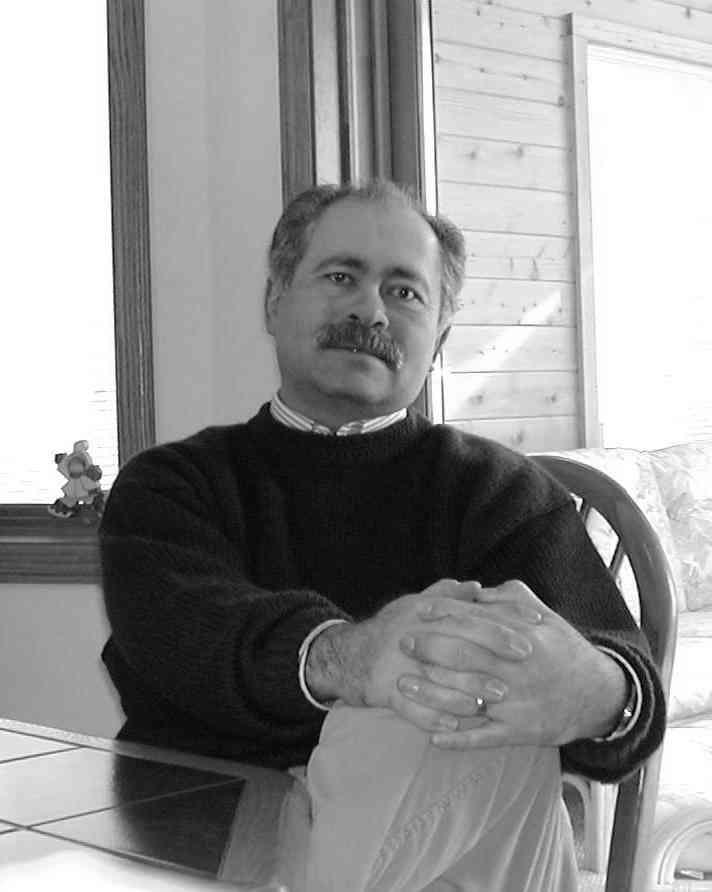
Mystery novelist Brian Lutterman started writing in the late ‘80s, when he had to abandon his law career due to Chronic Fatigue Syndrome. Although he was a trial lawyer, his two published novels aren’t John Grisham fare. Bound to Die (Salvo Press, 2002) brings the reader into the inner circle of a cult poised to take over the White House, while Poised to Kill (2004) is a corporate thriller with kidnappers demanding anti-missile secrets. Bound to Die begins with a mass murder, and from there it weaves an intricate plot of missing children, FBI agents, right wing militia groups and members of a cult known as the Bound. Entertaining stuff, to be sure, but while it’s got your adrenaline pumping the book raises some thoughtful points relating to the nature of happiness and the misuse of mood-altering medications.
Now a Vadnais Heights homemaker with two children, Lutterman is able to write—for short periods—in spite of CFS, and he’s a fan of Thomas Gifford, William Kent Krueger, and John Sanford, whose book Mortal Prey was a finalist with Bound to Die for the 2003 Minnesota Book Awards genre category (the much better known Sanford won). I met Lutterman at the Roseville Library Dunn Brothers for a chat and a cup of joe.
Joel Van Valin: What led you to write a mystery/suspense novel? Why not poetry, or horror, or a literary novel?
Brian Lutterman: My personal preferences and abilities. I try to stay with what I’m capable of doing.
JVV: In Bound to Die the highest echelons of the government are in danger, not from foreign terrorists, but a small cult operating within our society. Do you really think there could be such a cult?
BL: No. I believe the biggest threats are out there in the open. I’m not a big believer in conspiracy theories because I don’t think big bureaucracies can keep secrets. But in a way that idea led to Bound to Die. I thought to myself, What would induce people to keep a secret?
JVV: On the subject of cults—the Bound seem to have some similarities with career-oriented education and motivational seminars, such as Landmark. Is that intentional?
BL: Yes—but not Landmark specifically. I went to a “boot camp” when I was in the corporate world. The Corman seminar [in Bound to Die] has similarities. They really did try to strip down your defences and make you come face to face with yourself.
JVV: You write about a powerful psychotropic drug called Zest, a sort of super-Paxil. Do you think this sort of drug will be developed eventually?
BL: I honestly don’t know, but the prospect is frightening—and I’m frightened by the prospect of people who think that feeling good is more important than being good. Most psychotropic drugs make people feel normal (not depressed), but a new category [of psychotropics] makes people feel happier than normal. This is troubling.
JVV: Now for some philosophy, if you don’t mind. In Bound to Die, there is a debate of sorts about whether it’s better to live an unhappy life, or a happy life addicted to a drug. Our modern worldview—at least the Dr. Phil sort espoused by popular culture—sets happiness as its highest goal. And many ancients, such as Epicurius, argued that happiness should be our aim in life. Yet Tori [the heroine in Bound to Die] turns her back on the prospect of happiness? Why? What else is there?
BL: I think there’s a lot out there other than feeling happy. In fact, if you feel too happy it may be a sign that you’re not doing the right thing. Feeling good, in my philosophy, takes a back seat to acting, and bad feelings are an integral part of living life fully and understanding the world. Are we any more than cells and chemicals? Does consciousness exist? If our moods can be manipulated through artificial means, what are we? I don’t know the answer, but the prospect of finding out scares me.
JVV: Last—a question about your new book, Poised to Kill. It’s set in the corporate world. There’s certainly plenty of evil/greed to be found there, granted. But corporations are usually eschewed by writers for being a Dilbert world, a cultural black hole. Did you find this a challenge in writing your book?
BL: Not at all. Corporations are a great setting for displaying human conflicts and emotions of all types, and they bring out the worst and best in people and raise all kinds of significant questions about human experience. How do my characters react to the pressures of the corporate world? There’s nothing new under the sun but there are thousands of mystery authors with detectives doing everything imaginable. Yet none are in the corporate world. But I think the corporate world supplies a whole range of issues, and ratchets them up because of the tremendous pressure.