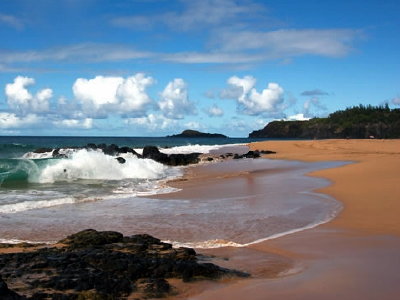
In February, husband and I escape from the northern winter, escape real life, and especially try to escape the death of our teenage grandson. we become beach bums. We soak up sun at Kauapea Beach in the afternoon and watch the sunset on Hanalei Bay before dinner.
At Hanalei Bay the sand is fine and packed, and the crescent-shaped beach at the edge of town is protected from the wind. There are parking lots, pavilions, and a pier. It’s a social place. Runners stretch their legs on the mile long expanse, their dogs running with them. Tourists gather to drink wine and watch the sunset over the mountains. Local families congregate in the evenings and on weekends to swim when the water is calm and surf together when the tide is high.
At Kauapea swimming can be dangerous. The sand is deep and coarse; the slope to the water steep. A crowded day at this beach is twenty people, most of them tucked in little shelters of the naupaka brush. There are two groups—retirees "wintering" on the island and young visitors, young enough to be our grandchildren, some living on the beach. All but a few are nude.
Every February afternoon husband and I drive the winding, one lane, red dirt road full of holes deep enough to bury the car, to Kauapea Beach. At the end of the bumpy ride is space for a few cars to park and a opening in a fence leading to a path.
We trek the narrow meandering trail from the cliffs down to the sea through morning glories and prickly lantana with child-like anticipation. Suddenly, around a bend, we step out of the brush to the blue green Pacific meeting the horizon.
There are regulars at Kauapea. A very browned and very large man, with a belly hanging over a knotted loin cloth and long matted frizzy hair, sits in the same spot near the path every day. He lives on the beach and purportedly feeds the feral cats, so is referred to as the cat man. He sits erect, back rod straight, hands to his sides, staring at the ocean. He nods to acknowledge our presence in his space as we walk by, but never speaks.
A retiree from 3M in Minneapolis hangs his white t-shirt on a walking stick to mark his spot on the beach. He puts his plastic beach mat on the sand, sheds his shorts, sits down, lights a cigarette, and begins his day. Eventually, he’ll take a stroll and stop to talk to other sunbathers—Minnesota Nice.
He gathers our stories and shares the information, creating an informal little community. He informs us that the Colorado couple come every winter for a month. They are both browned from the sun, though their guest, like me, prefers wearing a suit. Later in the month I notice she has succumbed to the lure of freedom from clothes.
The fisherman arrives in late afternoon. He walks briskly down the beach with his fishing pole, nodding as he passes. He claims his spot with a mat and a back pack, removes his tan shorts and polo shirt, and climbs the lava rock to fish. In real life, he was an accountant.
I walk along the ocean’s edge, soak up sun, and search for beach glass. Every afternoon for a couple of weeks, I meet the same tall, lanky young man wearing only bright pink wrap-around sunglasses. He’s looking for shells and always greets me somewhat respectfully with "How’re you doin’ today?"
We begin with the usual pleasantries... wonderful afternoon, great sun, good beach day...finding any good shells? Then we chat as we walk. He has been on the island for several months, working part-time, can’t find a full time job, so he’s thinking of moving on—to Australia. He’s lived there before.
Perhaps because I am wearing a bathing suit and remind him of his mother, he feels compelled to assure me that nudity on the beach is alright. He tells me he’s been a nudist for many years (though he can’t be more than twenty-five), knows all about the laws, and what is legal and what is not. He cites chapter and verse of past cases brought to the courts in Honolulu.
One afternoon he strides down the beach purposefully towards me. He is leaving the island and asks if I will take his photo. He wants to remember this beach. He poses so I can get the sand and the ocean, the cliffs and the sky in the background. The irony of our mutual comfort with his bare body and hot pink sunglasses, and the significance of his seeking me out, doesn’t strike me until I begin to write about the people I meet at the beach.
For several days, right next to the spot where husband and I are set up, a young man lies in the sun, then dons long white pants and stands on his head, holding the pose. He bends and stretches, reaching to the sky, then leaps to the ocean’s edge, graceful as a dancer. I’m captivated by the beauty of the ritual.
"Are you doing yoga," I ask, "or some kind of meditation?"
"Just exercise to keep my stomach muscles taut...to stay in shape."
He teaches break dancing in the Kilauea middle school just down the road, but he’s not a teacher. Eight months ago he became a member of the plumbing and pipe fitters union in Michigan. He’s twenty-two and decided he needed to see more of the world, experience something different before he "settles down". A friend of a friend of a friend has a restaurant on the island. He is working for her and spending free time at the beach.
He glances at a group of bedraggled young people gathered nearby—"it would be great to live like that...on a beach. Wake up to the sound of waves every morning."
"Would you really like that?"
And with a warm smile... "Well...not really."
Those beach kids come in on the path with water jugs and occasionally bags of groceries, usually in late afternoon. Sometimes they disappear into the brush and emerge later and sit in a group eating coconuts. We notice their dilapidated, rusty vans and cars parked at the head of the trail, and we recognize some of them hitchhiking on the highway to Kauapea. We often say, "tomorrow we will give them a ride."
One day strolling along, transported to tranquility by hot sun and waves lapping the sand, I happen on a boy looking for shells who is new to our beach. His hair is short. He’s barefoot but dressed—in clean, unworn shorts and shirt. He’s anxious to open a conversation, but evasive about where he comes from... "Uh...Olympia, Washington...been here awhile...came to the beach from Kapaa," a town 12 miles south. "I was told I’d find lots of young people living on this beach, but I haven’t found them."
He is looking for kahelelani shells for jewelry, but I realize as we talk that he knows very little about it, another clue that he’s new to beach culture. I ask what he is using to string the shells, and he tells me dental floss. I’ve learned from the jewelry makers over the years that they use fishing line, they separate the shells by size and color, and this beach isn’t a particular good place to find the kahelelani either.
We run out of things to say, but I feel his reluctance for our conversation to end, for me to walk on. He holds his hand out and offers me a large Tiger Cowrie, a scarce and precious shell he’s found among the lava rock. It’s my grandson’s hand. The last time I saw my grandson I noticed that his fingers were stubby but broader, the knuckles pronounced, no longer a boy’s hand, not yet a man’s.
I am aware then of the soft fuzz on the boy’s face. He is younger than any of the kids living on the beach or hitchhiking on the island. He’s not much older than my grandson who was killed in a car accident only three Februarys ago.
I want to take this runaway home and give him a place to sleep and call his grandmother. I want to tell her that he is alive, he’s well, but he’s lonely. He’s a nice boy, polite and kind.
I’ll see him again tomorrow. He’ll have found a place with the kids who live on the beach or in the woods beyond the beach, so he won’t be alone. I’ll find out more about him and won’t hurry to finish the conversation, so he’ll know a grandmother cares.
I walk the beach slowly the next day and the next, looking for him. But he never comes back.
Fantasies. Escapes. Epiphanies. At every age. On an island in paradise, I’ve escaped the northern winter, but not the loss of my grandson. I’m collecting keiki kane (sons) along with the green glass on a white sandy beach of Kaua’i. I’ve become the beach kapuna wahine (grandmother).
© 2005 by Niomi Rohn Phillips.