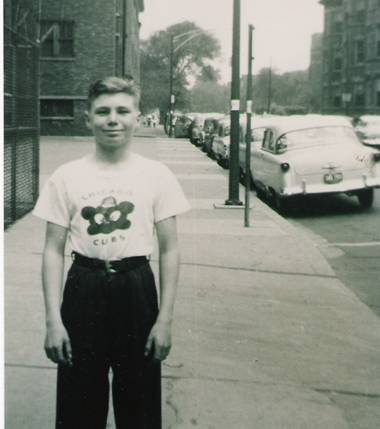
The Architect, who provides the genes and chromosomes that made up that complex structure which foretells our behavior and characteristics, must have included one tiny white gene with a curving red line around it, into my DNA stairway. What else could account for my love of baseball?
I was born on a cold and snowy November 11th in 1940, the same day that a freak Midwestern storm took the lives of so many others. I have only a dim recollection of my early years. The daytime scene, from our second floor apartment window, was that of steel and concrete. At night, the darkness was pierced by the colorful, blinking lights from the sign of the Aragon Ballroom. Every big band played at the Aragon-Frank Sinatra, Lawrence Welk, Tommy Dorsey, Benny Goodman, Glenn Miller. And those who weren't dancing at the Aragon were sitting at home listening to the show. I remember Bert Williams' account of the 1945 World Series as I watched the radio and rooted for the Cubs. It was that same radio that told me President Roosevelt had died in April of that year.
On the first floor of my building was a small café called the Jolly Chef. My mother worked as a waitress there and the clients were Cub fans who traded stories and talked baseball over a cup of coffee.
And I remember seeing Wrigley Field for the first time. The huge green and red walls and that once you entered, the smell of hot dogs and popcorn. I remember the red C with a little teddy bear playing ball inside of it. I loved Wrigley Field; there was green grass and ivy covered walls. The players were so close you could reach out and touch them.
There were the rays of sun and drops of rain that grew my love of baseball. They fertilized my imagination of becoming a Duke Snider leaping high against an outfield wall to take away an extra base hit and save the game for my team.
As a young boy, I found out there were ways to get into the ballpark without paying the fifty cents that I never seemed to have. If you were quick enough, at the end of the game you could run through the stands and pick up the seat cushions. You had to be quick because there were not many people at each game who rented a cushion and in order get a free pass for the next game you had to pick up twenty-five of those beer-soaked, ice cream-smudged things.
Worse yet, you could gather round Pete, along with fifteen or twenty other boys, and then proceed to walk through an entire row (from left field to right field) picking up the folding seats of the grandstand area. If there weren't enough boys to finish the job in one pass, then you had to turn around and do another row all the way around the park. Leaving one seat down in your row would invite a swift broom in the pants from one of the sweepers. But at the end of an hour you had earned your pass for the next game.
Free passes were great, except for one thing. The pass gate didn't open until noon. The grandstand and bleacher gates were opened at eleven and by the time you got in, batting practice was over. Now, batting practice is not that exciting to the average baseball fan, but, for the boy of ten, it is an opportunity to chase after a foul ball hit into the stands, or to talk to a player close-up from the box seats, (the ushers didn't chase you out until noon) or even listen to the jibs and horseplay as the pepper games were played in the outfield.
To pass the time (while waiting to get in the pass gate) I hung around on Waveland Avenue for any balls hit out of the ballpark during batting practice. This area is located behind the left field bleachers and is a residential neighborhood. A three hundred eighty foot homer would bounce right in the middle of Waveland Avenue and be followed by a dozen boys through hedges and lawns and flower gardens. The residents would tolerate us boys for a few days then they would be told, "Stay out of the yards or I'll call the cops." Well, we boys did until the next ball went into a yard and that started the ritual again.
It was one of those typical mornings (I was usually on the street by ten) that an usher I had come to know as Pudgie called to me from the left field stands to come in and work. I didn't care what the work was because I knew I was getting into the park two hours earlier than I would have. I picked up my things (lunch bag, baseball cards, and jacket) and accepted the awe and envy from my peers still on the street. Pudgie, in his Chief Andy Frain Usher suit, met me at the gate and led the way.
Each evening after the game is long over, after the vendors have left to rest their vocal cords, while the sprinklers are creating a giant rainbow stretching from the third base dugout to centerfield, the sweepers are busy moving the empty beer cups, popcorn boxes, pen-marked scorecards and other remains from the afternoon's three hour spectacle down to the front row of the box seats.
The Box Seats got their name from the three sturdy red pipes that enclosed eight heavy, green wooden chairs. The sweepers would start at the top row by moving the back four chairs out into the aisle that separates the grandstand fan from the Box Seat elite. The sweepers worked down, moving each row of chairs back until the front row was covered with the aforementioned remains. It would take about two garbage trucks to remove the trash; attendance wasn't that great in the early fifties.
When Pudgie and I reached the Box Seats there were six others waiting for us. Pudgie rolled the unlit stub of a cigar to the side of his mouth and with some unintelligible command formed us into an old fireman brigade. I hooked my glove through an empty belt hook and took my place. The chairs were passed down from the top to the bottom and set in place. As each aisle was completed we moved to the next. It took about an hour to replace all the seats.
The work wasn't hard but those chairs were. They would snag a pair of corduroy pants or even worse, knock a shin right up through your knee so that for three or four aisles you moved as if you were concealing a baseball bat in your pants' leg.
Pudgie said something that, loosely translated, invited the crew to the Ushers' Room to wash up. I walked along with an older gray-haired usher who had introduced himself as Tates. Later I discovered that Tates was the field announcer for that other park on the south side of Chicago. Tates was well spoken and he told me that the work took longer this day because of the double header yesterday.
The Ushers' Room was tucked under the grandstand near the Cubs' dressing room. As we were entering, some of the players were heading down the ramp to the field. Here I was in the Ushers' Room away from the chance of catching one of the few balls hit out on Waveland Avenue.
Pudgie snubbed the cap of a Dad's Root Beer and set it in front of me. "Some things you should know." I understood all the words and even his manner was different. "You can sit in the stands but don't get in trouble." I might not have heard the rest because I knew there would be no trouble from me. "-be here at nine-thirty tomorrow and you can be in the same crew."
He handed me an employee's pass with his signature on the bottom and something that looked like my name on the top. He had copied it from the strap on my glove, Mickey Klatt, Employee, Chicago Cubs. I wasn't doffing my cap to the crowd but it felt like it.
What more can a boy ask? I had moved to a first row box seat next to the Cub dugout. The sun was warm and the pitchers were taking batting practice. The pitchers take early batting practice for two reasons: first, they don't want anyone to see how poorly they hit and, second, so that later they can run back and forth across the outfield like moving targets when the regulars are in the batting cage.
Pitchers are left handed or right handed, but to hear them talk it was always the hit they had got or the long drive they belted that the shortstop caught. For Bob Buhl it was the foul tip he once had! No pitcher, not one, likes to shag the outfield balls. It usually took the emptying of the ball bag before one of them would go out and retrieve a few.
I stood up to my full five feet four inches and in my deepest voice called out to Bob Rush, who was heading out to left field after the balls, "Can I help you shag?"
The question caught him off-guard. "Do you know how?" was the reply.
I was over the four foot brick barrier between "know" and "how" and explaining how I had played two years with the Thillins Little League and other earth-shaking bits of information, knowing if I kept talking Bob Rush couldn't say no.
There I was. In left field of Wrigley Field. I was standing in the same spot that Hank Sauer stood; some of his used Beechnut was in the grass. I looked back at the ivy-covered wall and it seemed a lot higher than I had imagined, and there were wires to hold up the ivy. Crack! The sound that only a baseball, rebounding off a bat, makes, echoed about the park. I looked up. The ball was over the upper deck heading my way. Automatically I stepped back a few feet and reached up. The ball landed right in the pocket of my glove. It felt like a cannon ball and I knew my hand was now located just below my elbow. I had caught a lot of baseballs but never one hit that hard.
I picked the ball out of my glove. It was grass stained and scuffed. Had to be cool was the message I was sending my hand and I threw the ball towards the infield net which was set up to protect the player in charge of keeping the batting practice pitcher supplied with balls. It landed about fifty feet from me and a hundred feet from the net. Bob Rush, who no doubt knew what had happened, laughed and said something about good glove, no arm, as he headed back to the batting cage. I was in.
I was all over the outfield fielding the errant hits. My throwing improved-well, I was able to reach the infield anyway. I tugged at my cap, took a stance that I thought resembled Richie Ashburn's, and played every ball hit my way as if it meant the World Series. Being out there was like the last day of school, the Fourth of July, or the day the mailman delivered my Straight Arrow Ring with me pictured between Straight Arrow and Fury (I had sent two Shredded Wheat box tops and fifteen cents for it). Such are the things dreams are made of.
© 2006 by Julia Klatt Singer.