During the war years, my father wrote a weekly newsletter for those of his employees serving in the armed forces. In the four-page missive, he reported on events taking place at the hardware store and in the community. He also told a few funny stories. He was my inspiration. I wanted to write a newspaper. Mine too would be a patriotic effort designed to inform neighbors of our victory gardens and Dad's beekeeping venture, of air raid wardens' meetings, and Red Cross bandage rolling sessions.
I dubbed my newspaper The Dame Paper, to distinguish it from my father's.
For Christmas that year, my parents gave me a child's typewriter with rubber keys. I placed two pieces of carbon paper between three sheets of plain white paper and began typing with two fingers sharply hitting each key for a firm imprint. Tap, slap, the stories began to take shape, and I repeated the process six times for six copies. I then walked to each neighborhood door to personally deliver my paper.
"Thank you, dear," said Mrs. Cleveland, as that summer day I pushed a copy, hot off the press, into her hands. "What do we have today?"
The headline, Mr. Case Gets His Queen at the Depot, didn't surprise her. "I heard your father has a new hobby." She was talking about Dad's decision to raise bees. "I do hope he keeps them on your side of the fence," she laughed.
I nodded. "It's his war effort. He has a bad back and can't fight." Part of my patriotic duty, I felt, was explaining why my father wasn't in the armed services.
"Your father's a good man, even if he is a Democrat." She looked me squarely in the eye. Her broad brow furrowed.
"What's wrong with that? Isn't the President a Democrat?" Even Mother was loyal to Mr. Roosevelt. At the dinner table we talked about how we always had to respect the President. He was our leader.
Mrs. Cleveland put her hand on my arm. "That's the problem. Out here, people like us are Republicans. I know your mother is. Just like her own family."
I shuffled back and forth on my feet, trying to figure out some way to defend Dad, but I didn't know enough about these matters to say more. "Thanks for reading my paper, Mrs. Cleveland. Can Libby make lemonade today? We want to set up our stand."
"Sure she can, I'll give her some lemons. What else do you have in your paper? Ah, a recipe for lettuce and radish salad from our Victory Gardens."
I was thrilled she'd notice that. I had been careful to caution my readers not to overdo the sugar. "It's rationed," I'd typed, just to remind everyone to do his part.
I especially loved writing about my father, the honey-maker. I think now he might have buried the disappointment he felt over being 4-F by pouring his energy into writing the newsletter and producing the honey. As a substitute for rationed sugar, honey was a patriotic product. So Dad read instructive manuals, ordered equipment and protective clothing, and set up four hives in our backyard under the apple trees. He had no farming experience, and I thought he was brave enduring bee stings.
To begin, Dad poured over dozens of bee catalogues looking to select the right Queen. These regal matriarchs traveled by train in special wire mesh cages from faraway places like Baltimore and Savannah to the depot in Wayzata, our suburban Minneapolis town. The day they arrived, the Great Northern station manager, Mr. O'Laughlin, hastily telephoned Dad at his office. Bill O'Laughlin was a small man, wiry, sharp-nosed with a ready Irish smile. Each day he operated at full steam, receiving freight, assisting passengers, and handling the flow of telegrams. Arriving from the east and west coasts, passenger and freight trains made frequent stops, and a special commuter train carried businessmen to and from Minneapolis. The Western Union telegraph machine clattered incessantly, tapping out good, bad and neutral messages-purchasing orders, congratulatory messages, vital arrivals, and the terribly sad news of loved ones missing in action or killed in the military campaigns raging in Europe or the Pacific.
"Mr. Case, your Queen's arrived," Bill O'Laughlin told my father. "Please come soon." He meant immediately.
I was on the platform to greet my father as he stepped down from the evening's commuter train to collect the Queen. Dad took of his hat and bowed to Mr. O'Laughlin.
"Thank you, sir, for taking care of my Queen. I'm here to escort her to the palace."
Mr. O'Laughlin laughed.
The Western Union machine was making a racket. "What'd you say, Dad?" I was at his side. "Say it again for the paper."
"There'll be another one coming soon, Pol," Dad said.
"Like the streetcar," I said.
"Like the streetcar." Dad smiled at me as he tucked into his briefcase the wire box with its angry prisoner. My father had such a quick sense of humor. He made people feel good, they liked his quick simple jokes, and they usually asked him to "tell it again". But he never did. Soon, he knew he'd come up with another funny line. Dad and I said goodbye to Mr. O'Laughlin and set off up the hill to our place.
While Dad changed clothes, I stood guard over Queenie beneath the apple trees. Soon he was back, dressed in his khaki-colored overall suit, with white cotton spats wrapped around his ankles and strapped around his shoes to keep the bees from dashing up his pant legs. He wore long canvas cotton gloves and had a big khaki cloth hat with a heavy veil that fastened under his chin; whenever it wasn't fastened securely, hostile bees climbed in and stung him. And when they did he couldn't trap an insect quickly enough-difficult with those awkward, stiff gloves. Poor Dad was often stung.
But that day he was ready to install the Queen into her hive. He carefully opened the top of the hive that teemed with worker and drone bees, then lifted the Queen's box, pulling out a small cork from the bottom of the box, that revealed a wall of sugar protecting Her Majesty.
Catching a whiff of her, the worker bees quickly gathered to eat the sugar and Dad replaced the top of the hive. Now the matriarch was in command of her family, the hive was abuzz, and moments later my typewriter was humming.
On weeknights and each weekend Dad tended his hives, and by summer's end, he was ready to extract the golden honey, an all-out effort. Saturday morning several fellow hardware company employees would come over to join Dad in setting up the heavy metal extraction drum and turning the pipe-like crank. From each hive they then gently removed waxy trays and placed them, four at a time, in the extractor where they speedily whirled around. Taking turns twisting the crank, the men chortled gleefully as the heavy liquid sloshed around inside the shrieking machine.
And then the gift appeared-golden apple or amber clover honey poured out through a spout and into a huge container. The men checked the honey for obvious impurities as they decanted it into dozens of glass jars. I pasted on the bright red and yellow labels, "From the Apiary of Benton Case."
After several successful harvest years, Dad brought eight more hives and an electric extractor, and each autumn he produced enough honey to give everyone in our extended family and all our friends gallon jars with some left over to sell at the church.
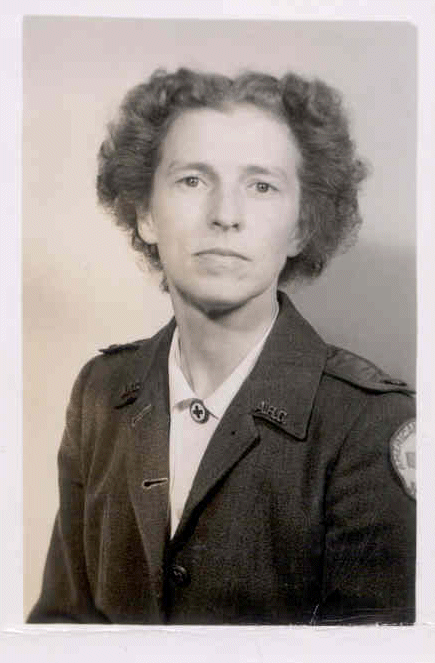
Mother began her "war effort" several months after Pearl Harbor. She was a Home Service officer for the Minneapolis branch of the Red Cross. Wearing a handsome blue uniform and cap, she gave a full day each week to this volunteer work, assisting families who needed help and information about their men and women in service. If there was a family emergency, Mother contacted the service person and his superior officer to request a home leave.
For The Dame Paper I recorded Mother's most exciting days as she was assigned to round up soldiers or sailors who were AWOL. She stalked Washington Avenue in Minneapolis, not far from Dad's store, where these servicemen gathered in dark smoky bars. On those nights Mother would arrive at the supper table slightly flushed, her eyes sparkling from a successful roundup.
I'd hound her for news. "Tell us Mother, but wait, wait. I want to write this for the paper." I ran from the table for a pencil and piece of paper. Luring some poor soldier from a dark, mysterious bar would be my big story for the week.
"We started down Washington Avenue, Mrs. Carson and I, no point in going into any other bar but the Persian Palms, that's their hiding place, all that smoke and noise. This was Emma's first time on the beat, so I was showing her how we do it." Mother's renditions of her tale were always compelling, and no matter how many times I heard the stories, I would wait on pins and needles for the tale.
"What do you do when you get into the bar?" I asked.
"We walked quietly around the bar and into the back rooms. There were several men in uniform. I told Emma we would ask each one his name, and we started with the one behind the jukebox. We asked if he was Private Haskins."
"How do you spell his name?" I interrupted, pressing down hard on the pencil.
"HASKINS." Mother was going strong. "He's from Hastings, just down the river. Poor man, he hung his head, and mumbled, `Yes, I am.' `Well,' I said, `we've been looking for you. Your family is very worried, especially your mother as she isn't well.' When I told him his mother was worried, he began to cry."
Mother shook her head and looked sad, and I waited patiently for the rest of the story. No sense in pushing now.
"It is sad," she said. "They don't want to fight. They're all so young and scared. Private Haskins asked to talk to his mother, and we told him that was fine and took him off to the Red Cross office where he called his mother and his reporting officer. His mother burst into tears."
Dad would look up from his dinner plate just about then, smile at Mother and say something like, "I wish I'd known you were lunching at the Persian Palms, I'd have walked down from the store and joined you." And Mother's face would brighten, and she'd laugh as she always did when Dad teased her.
"Do you spell Persian with a `z' or an `s'?" I asked. I took my reporting duties seriously. I could see my parents eyes flickering as they looked at each other down the table.
"How do you all like the meat loaf? We're stretching the meat coupons this week. Plenty of bread crumbs." Mother picked up her fork for another bite.
"No onions?" Dad asked that every night. He hated onions.
I had my headline by then: Polly Case Captures Private Haskins.
The Dame Paper had a life of about two years, covering the growing cycles of our victory gardens and frequent dog fights and additions to our menagerie. We had three pigs and some chickens in our backyard, and our cocker spaniel bitch, Tinker Belle, produced four black- and sandy-colored puppies in her whelping basket in the back of the garage. Each autumn Dad told us that our spring piglets would be pork and bacon for dinner, and although my brother and I named each one, we tried our best to accept this, like everything else, as part of the war effort.
© 2006 by Polly Grose.