The 50-year marriage of my great uncle See-See was our family's elephant in the living room. References to the marriage were infrequent, veiled, and never discussed. While See-See resided in my grandparents' tiny house for more than four decades, neither my father nor his eight siblings ever laid eyes on his wife, Maria, or saw a photo of her.
Everyone, including my grandfather, called him See-See, though Pasquale was his name. I'd been told as a boy that see-see was something of an Italian diminutive, an affectionate term referring to one's uncle. I learned years later that this wasn't authentic Italian, but came from the dialect indigenous to the Region of Calabria at the toe of Italy's boot-a mélange of Italian, Albanian, Greek, Saracen, Norman, and Spanish. My father's family pronounced uncle "see-oh" instead of the correct Italian zio (tsee-oh), and regarding their Uncle Pasquale, shortened it to just the first syllable, but saying it twice. When I said "Uncle See-See," I was in effect, calling him Uncle-uncle-uncle.
See-See was a man of few words, and though he died in 1946 when I was six, I distinctly recall his presence in my grandparents' kitchen. Each Sunday our large extended family would gather at the house in Duluth's West End neighborhood for a ritual meal of antipastas, pastas, meatballs, sausages and dolci (sweets) prepared by my nonna. The affairs were boisterous, with everyone gesturing, shouting and laughing as food was passed and enjoyed.
But when the Fedo clan squeezed around the dining room tavalo, See-See chose seclusion in the kitchen. Toothless, with a brown poor-boy cap pulled low over his hairless head, he'd sit on a white wooden chair in the middle of the room beneath a bare light bulb that descended from the ceiling on a cord. It was a scene reminiscent of Booth's New Yorker cartoons without the presence of demented dogs.
I retained a fondness for See-See, though I can't recall a single exchange of words between us. Perhaps my affection stemmed from the time he stopped my father from disciplining me for some boyish infraction. As Dad began to remove me from the kitchen, See-See hoisted his cane, menacing Dad, who acceded.
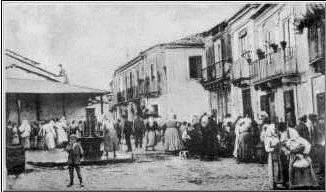
In the summer of 1904, three Fida brothers sailed from Naples to America, escaping the cruel poverty of Rosarno and all of Calabria. Uncle See-See, the eldest and only married brother, stayed behind. Giuseppe settled in Bridgeport, Connecticut, while Salvatore and Giovanni moved to Minnesota's Iron Range. Upon learning that two brothers had secured immediate employment in an Aurora, Minnesota iron mine, Pasquale packed up his two oldest sons, Francesco, 12 and Beniamino, 8, and joined them. What I didn't discover until much later was that See-See left Maria and their two year-old son Pasquale, Jr. in Rosarno. Apparently the plan was for See-See and the boys to find jobs, send money home, and eventually save enough to bring Maria and Pasquale, Jr., to America. None of the American Fedos ever brought up the subject of See-See's wife and third son, until a decade ago.
A few months before his death, my father began to speak of his immigrant family. He disclosed that three of the four Fida (fee-da) brothers received the name Fedo (fee-doh) from immigration minions at Ellis Island in 1904. In the course of saying he knew very little of their lives in Italy, or even much of it after he was born the second of nine children to Salvatore and Amelia Fedo, Dad broached the long-unmentionable issue regarding his uncle Pasquale.
A few years earlier, my brother David discovered the existence of cousins back in Rosarno. I asked Dad about the connection. "They're See-See's people," Dad said, and sat forward, his elbows on the kitchen table, large hands cupping his jaws. It was a pose he'd assumed during the later years of his life, when he wanted to impart a story-a contrast from his aversions to them for most of his 90 years. We'd grown closer in the five years prior to his death, and now he found pleasure in sharing yarns about his growing up in Duluth's Little Italy neighborhood.
As he went on to resurrect old Pasquale, Dad said his uncle joined Giovanni and Salvatore in Minnesota, but found life wasn't much better than in Rosarno, where Pasquale had been a cobbler. "I don't think he was a very good one," Dad said, "or he could have worked as a shoemaker here too. As far as I know, he never did." He and his boys eked out a hardscrabble existence for ten years, failing to save enough money to bring Maria and Pasquale, Jr. to America.
"See-See didn't talk much," Dad said. "So who knows what he thought about anything? He used to go off to work with Pa in the mornings, but did they work at the same place? Nobody asked, so nobody knew. Maybe he just took a streetcar downtown and sat around with the rest of the bums."
After a while Dad straightened up. "See-See gave me my first horn lessons, though. He used to be a decent musician, but how he ever afforded an instrument is beyond me. Give him credit for knowing music. He'd sometimes sing Verdi or Puccini in the kitchen if he thought nobody else was around."
Dad allowed that descendants of Pasquale, Jr., were probably still living in or around Rosarno, but he had never bothered looking them up on his two junkets to Italy. "There wouldn't be anything to talk about," he'd said. "I can't remember my Italian, and it's not likely they knew any English, so what's the point?"
I found the language barrier reference amusing. Italian neighbors in Duluth used to joke that during his forty-plus years in Minnesota See-See mostly forgot his Calabrese Italian, while concomitantly hadn't acquired much English, leaving him bereft of both languages.
My father chuckled at the recollection, but sobered as he began to explain what I didn't know about See-See and the Calabrese cousins-cugini, Dad called them-and the ignominy that kept Dad and his siblings from visiting the Rosarnese cugini.
"After See-See had been here quite a while-years, really, Beniamino was a problem. I guess today they'd call him a wise guy, like on `The Sopranos'. He was a punk, got into all kinds of trouble with the law. I remember going down to the jail with your grandmother, who'd bring him a bowl of spaghetti every Saturday when he was in the pokey. Anyway, he wasn't a citizen, so after maybe the fourth or fifth time he was arrested, they deported him." My father told me that while it pained Pasquale, it hurt my grandmother even more. She thought Beniamino could be salvaged if he stayed in her house, attended Mass at St. Peter's, where all Duluthians of Italian descent worshipped, and ate her homemade pastas and sausages.
But Beniamino was too far gone, Dad said, and it was assumed he preferred the criminal elements in Italy to facing prison time in Minnesota.
Some months after Beniamino's return to Rosarno, it was reported that he sent a letter to his father. When the young man arrived at his mother's home, he saw not only young Pasquale, now about 13 years old, but also a seven year-old little girl who called the lady of the house "Mama."
Furious, Pasquale terminated correspondence with Maria, and ceased spousal support. The relationship was finito. Maria, however, persisted. In a passionate letter she wrote that in all the years of Pasquale's absence, he was a continual presence in her thoughts and dreams, some of which, she reported were exceedingly vivid. In one of them he came to her bed and they had made love. So vivid a dream, she said, had to be true. The little girl was the product of that dream, and on the Blessed Virgin, the child was Pasquale's.
The Calabrese were deeply superstitious, even while fervently embracing Catholic dogmas. My father's people attended daily mass, but still harbored fears that someone might give them il mal occhio-the evil eye-which inevitably meant misfortune or suffering of some gravity. Perhaps a few early twentieth-century Rosarnese might have accepted Maria's explanation for this second Immaculate Conception, but not See-See. Though unschooled, See-See understood the improbability of such an occurrence, and forbade the mention of Maria in his presence to the end of his days.
No one in the family ever heard of See-See's namesake again. However, I would learn that he died in 1969, still in Rosarno, a town despised by the American Fidas for the misery they endured. My grandfather Salvatore's bitter memories included foraging for food in dumps as a four year-old orphan until at 16 he volunteered for the Italian army, where he received dependable, though meager meals and lodging. He considered as bonus his private's salary of ten cents per week, from which he would purchase two packs of cigarettes at four cents each, saving two cents for candy or other sundries.
Our family was never able to ask about his life in Calabria without him scowling and waving a dismissive hand. "Basta," he'd say. Enough. And the conversation, not quite begun, would terminate. I only knew his thoughts about the homeland because in 1959 he and I traveled to Detroit to visit his daughters and grandchildren-my aunts and cousins-and during the day while the adults were at work and the kids in school, my grandfather and I were alone. We talked, and he recalled Italy-Calabria-and the mean, impoverished life he left behind. But he never spoke of this in any detail to his own nine children.
The germ of my desire to connect with the family in Calabria likely was born during that long-ago visit with Salvatore, who upon arriving in America, purged himself of his Italian name and was known in the new country as Sam.
I remained curious about what had happened to Beniamino the "wise guy," as well as the illegitimate child of Maria's and her unknown father. I thought maybe my father did too, but he died before my brothers and I would travel to Calabria in the summer of 2004.
Three years before we departed, David located the addresses of 20 Fidas in and around Rosarno. He wrote to all of them, wondering if any might be related to our great uncle. He received five replies, including one that began, "I Rosario Fida, deaf and dumb since birth, have nevertheless fathered 11 children." The prolific Rosario added he didn't know if we were related, but would be pleased to have us visit.
Another respondent, Attilio Fida, indicated he was the grandson of our uncle Pasquale, and emphasized that Rosario was not. David maintained a sporadic exchange of letters until six months before our scheduled departure. His last two missives went unanswered, and we thought perhaps our cousin had passed away.
Meanwhile, David had also learned we had shirttail relatives who owned a tuna cannery in the fishing village of Pizzo. Since Pizzo was only 20 miles from Rosarno, and the existence of distant cousins was known, we decamped there, eager to inquire about the descendants of Pasquale. But the Pizzo cugini, whose name was Callipo, did not know the Rosarno Fidas. However, they shared a similar indiscretion with the Fidas, though were less secretive about it. Giuseppina, the great-great grandmother of the present tuna magnates had been a consort to a baron during the worldwide depression of the 1890s. Her service brought both shame and survival to her family, as she was the only means of support, owing to the baron's generosity. Several years later the baron gave her the tuna cannery, which the Callipos have maintained for more than 100 years.
The city of Rosarno (pop. 15,000), though situated on the coast of the Tyhrennian Sea, is not noted for beaches or other diversions, and American tourists are almost unheard of. Recently the town has been beset with Mafia issues. Following years of persistent pressure by Sicilian polizia, the criminal enterprise expanded to Calabria. Moving across the Strait of Messina to Calabria seemed logical to Mafia dons because, as we learned from a Pizzo businessman, there were only two police officials in the entire region assigned to investigate organized crime. Franco, our B & B proprietor, argued we should not visit Rosarno, saying he would not be comfortable with our traveling there. But we could not be dissuaded.
We drove to the Rosarno Municipio, hoping to find out what happened to Attilio Fida, and to perhaps discover other relatives in the region. Officials at the city hall were helpful despite language difficulties, and the deputy mayor said Attilio was not only alive, but was a friend. He phoned and our cousin hurried to meet his long-lost relatives and cart us off to his home. Through a translator, Attilio said he'd never received David's latest letters.
Within minutes of our arrival, food magically appeared, brought by other relatives who lived in the same middle-class neighborhood. Attilio's oldest brother Fortunato carried in several gallons of his homemade red wine. Long tables were set in the garden beneath trees heavy with ripening apricots. Nearly 40 Fidas and Fedos sat down for a spontaneous welcome home, get acquainted feast.
See-See's grandchildren-Fortunato, Rocco, Atillio, Clara, Maria Rosa, and Maria, a nun stationed near Rome who was not at the reunion-ranged in age from 60 to 73. None of them ever saw their grandfather. Yet he retains icon status among the Rosarno Fidas, and each of his grandsons named one of their sons after him. During the 1970s, there were three little Pasquale Fidas gamboling on the Via Nazionale, where the families live.
Upon learning that I was the only one present who had ever known old Pasquale, Fortunato and Maria Rosa wept and Maria Rosa produced photos dating to the 1870s: a five year-old See-See with his mother-the first photo I had ever seen of my great grandmother-another of him as a young man in an Italian army uniform, finally as an adult shortly before his departure for America. In this latter he is erect, rangy, unlike the stooped and toothless old man of my memory. There is also a photo of a lovely Maria, she of the Immaculate Conception, at about age 30. Maria Rosa pressed the photos of her grandparents to her breast, wept, and embraced me, moistening both sides of my face with her tears.
In this moment, pungent with reunion and loss, I was unable to broach the subject of Maria's love child, and whether her relations were included in this gathering.
We did learn that Beniamino became a "businessman" and served as an interpreter for Allied troops after the invasion of Italy. But the family never heard from him after 1950, learning only that he had died in Rome sometime during the 1960s. No one knew the manner of his death, and seemed uncomfortable talking about him. Our cousins said he hadn't stayed long in Rosarno after he'd returned from America, and were content to let the matter drop.
While thrilled to have met my long-lost relations, nagging questions remained after I departed Rosarno. Who was Maria's daughter? Who was the child's father? My cousins must have wondered about their grandfather, why he never wrote or visited. That he might have abandoned Maria could be understood, but what about little Pasquale, Jr.? Italians, so noted for family attachments, do not forsake their children or aged parents. There are very few if any nursing homes in Italy, and day care centers for children are also rare. It goes against the character of these people to not nurture children and care for the elderly. But my great uncle left a wife and child without communication for the last 30 years of his life. Why would my cousins so revere such a man?
Still, the presence of the first Pasquale was palpable during our visit. Conversations were sprinkled with references to "Papa," who left for America never to return, and who never, as far as I knew, wrote letters, sent money, or remembered birthdays after his apparent cuckolding.
Back home in the states, my brothers and I continued to receive occasional notes from cousin Attilio; in several he asked about the absence of communication from his first cousins-Pasquale's American grandchildren-whom David had phoned following our connection with the family in Rosarno. Attilio reported that he had written three letters to each cousin, but had received no response. When my brother attempted to intervene on Attilio's behalf, he too was stonewalled.
Other American cousins tried recollecting comments about See-See that their parents had made years before. Several of my octogenarian aunts were asked about See-See and the story of his wife's infidelity. Responses varied; while all had heard the account, some doubted its veracity. From one came this oblique observation. "They used to say that See-See was something of a ladies man."
Was this the answer? Was the infidelity See-See's rather than Maria's? If so, had See-See fathered an out-of-wedlock child?
I am four or five years old, visiting at my grandparents' home. Two strangers are present. One is a woman with protruding dark moles on her face and neck, and whose thin, black mustache draws my attention until my mother nudges me and whispers that I must not stare. With her is a whiny, fat girl about my own age that the woman calls Sylvia. I am urged by other adults in the house to be nice to the girl and go outside to play with her. Fortunately, Sylvia throws a tantrum and refuses to join me. I spend the rest of the afternoon beneath Grandpa's apple tree, tossing its wind-fallen fruit at the abandoned chicken coop in the backyard. At dusk, Sylvia and the woman leave the house with Dad's bachelor brother Frank, get into my uncle's Pontiac and head down the hill. Sylvia and the woman absent themselves from my mind. I never hear of them again, but in recent months I am haunted by their presence in my grandfather's house, and I think I recall seeing the woman gently fondling See-See's hand as he sat in his kitchen chair. Was this woman his daughter or daughter-in-law? Was the fat, unhappy Sylvia his granddaughter? Our family's allusive communication pattern persisted, so my questions are met with shrugs, or terse pronouncements such as "Who knows?" "Could be," or "Your guess is as good as mine." Other American relatives have no recollection of either Sylvia or the woman who accompanied her on that long-ago visit.
I have recently considered the notion that Maria Fida had become in the parlance of those times, a "white widow"-a reference to wives abandoned by the thousands when their husbands left to find work in America or Australia. See-See may have chosen to forget Maria, an easy task, as no one in the family would ever make inquiries about her or Pasquale, Jr.
Basta, as Salvatore used to say. Enough. That I am no closer to learning the whereabouts of a cousin who may or may not exist is something I'll live with, at least for now.
© 2006 by Michael Fedo.