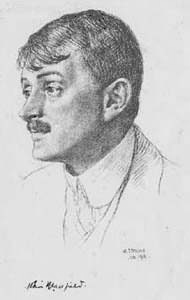
John Masefield was an unlikely poet and an even more unlikely poet laureate of England. He is known as the pre-eminent poet of the sea and seafaring. Everyone knows the opening lines of his famous poem Sea Fever:
I must down to the seas again, to the lonely sea and the sky,He was born in 1878 in the West Midlands. Hereford is nowhere near the sea. The closest Masefield came to the sea as a child was the local canals. He was forced to go to seafaring by circumstances at home, and only spent a few years there. Largely, he disliked the experience. He even jumped ship in New York, preferring to starve and do odd jobs.
The real story of his life is much more interesting than you might think from his poems. Masefield suffered from a lot of early tragedies. His mother died giving birth when John was just 6. His grandparents both died when he was 8. His father, a lawyer, suffered a mental breakdown when John was 12 and died in a hospital a year later. To solve the overcrowding which was caused when the orphaned Masefield children were forced to live with their aunt and uncle, John was sent to sea on the cadet ship H.M.S. Conway when he was 13.
Although he grew to dislike the life of a seafarer, Masefield initially enjoyed his training on the Conway, because they welcomed his bookish ways and encouraged him in writing down seafaring tales told by the experienced sailors, who acted as teachers on board. At 16, after graduation, John signed on to the four-masted ship Gilcruix bound for Chile by way of Cape Horn. In 1894, the world fleet of four-masted ships was diminishing fast. In fact, this was very nearly the last year that such a great adventure could be embarked upon. Though he enjoyed the natural wonders of the sea, the physical dangers of sailing the oceans in ships designed and built in the 19th century was brought home to him on this voyage. The sailor's life had changed little in a hundred years. Hard work, great dangers, and an early death were the most common expectation. Sickness was an ever-constant threat as well. In Chile, he succumbed to sunstroke and returned to England on a passenger ship.
When he got home, he discovered to his dismay that things were still as bad as ever; he was more or less forced to sign on to another ship-this time bound for New York. By the time he arrived, after another rough passage, he knew that he was too weak to survive this work for long. He jumped ship in New York at 17 and began to seek work. He did farm labor for a time, sleeping outdoors and begging food from his employers. Finally, he obtained a job as a bartender's assistant in O'Connor's Saloon, a well-known New York tavern, and later as a mill worker in a carpet factory. During this time, his desire to write about the sea blossomed, and he produced many of the prose and poetry tales that later appeared in his books. One benefit of regular hours was that he was able to read voraciously. He obtained his real education in literature by his own hand.
When he was 19, he returned to England and found work as a bank clerk. While in London, he attended museums and soaked in the history of the world from the physical objects that remain behind. He contemplated becoming an art critic for a time, but continued to write sea stories and poems. When he was 21, he finally published his first verse, later titled The Turn of the Tide, excerpted below.
I shall hear the ships complain' and the cursin' of the crews,Already in his first published poem, he exhibited an extreme attention to detail and the effort to reproduce the sing-song language of sailors at sea. By the turn of the century, England had lost its naval dominion, but English readers were nostalgic and liked to think of their country as a sea power. It was hard to resist Masefield's authoritative voice and the authentic sound of his narrative verse.
Masefield went on to write lots of poems about the land, but none are remembered as well as his sea poems. Although it is pretty well forgotten today, Masefield's most popular poem was one he wrote while on a walk in April entitled The Everlasting Mercy. The poem begins with a character named Kane who is a liar and a cheat who discovers everlasting mercy in the wonders of nature. To modern taste the poem is a bit sappy, but in 1908 it was welcomed for its fresh approach to the supernatural.
Over the many years that followed, John Masefield wrote newspaper articles, book reviews, plays and novels, as well as a steady stream of his famous sea narratives. He wrote a lovely poem to his mother, who died when he was young.
C.L.M. by John Masefield
In the dark womb where I beganJoseph Conrad was also a sailor/writer who washed up in England about the same time, and made his livelihood by writing about his deep ocean experiences, but there is one big difference. Conrad was a real sailor, cabin boy to captain, for 21 years, a full third of his life. Like Joseph Conrad, Masefield viewed the sea as a metaphor for the turbulence which is life and the steady work and dedication that it takes to tame it. But unlike Conrad, Masefield hardly had a taste of real sea voyaging, just two trips really, and these only one way.
I can find no record that Masefield and Conrad ever met, but one could excuse Conrad if he dismissed Masefield as a charlatan. He may well have felt that John Masefield was a phony, a man trading on the sea just because it was a popular subject.
He writes in Sea Fever, "I must go down to the seas again," but Masefield never felt that way. He dreaded the sea. "For a wind's in the heart of me, a fire's in my heels." Pure balderdash!
I suppose it raises the question: if a poem tells the truth- and even tells it beautifully-does it have to be honest as well? Sylvia Plath has been said to have written her highly emotional poem Daddy on a dare to prove that a good poet, like an actor, is capable of putting any emotion into words, even if there is no reality behind it. It offends our understanding of what poets are supposed to be doing, but is it strictly wrong? Masefield's poems are great seas poems, perhaps the best ever written, but are they true to his life? And does it matter?
© 2006 by Gary Lehmann.