Loud. Decrepit. Nauseating. Decayed. This is a place I know I will never forget. It overflows with destruction, oozes the rotten stench of death, and physically leaks an unprecedented form of hate. It is a place where most people dare not go despite the number of magnetic yellow ribbons they've tacked to their car. This is the heavily populated town of Samarra, Iraq.
This is the town that Achmed built.
We entered the city today as we've done a thousand times before. Iraqi Army soldiers patrol the streets like police during the sixties' civil rights protests. Every day the soldiers are scattered about the city at various checkpoints, but today they are everywhere. They wave to us and continue to patrol as if the city depends on it. It does.
It's Thursday. The insurgents with a jihad on their agendas want to kill infidels today and brag to God tomorrow. Tomorrow is Friday, the Muslim holy day. An infidel, by the way, is not Christian. An infidel is not Jewish or Buddhist or Hindu. An infidel is not an American or a Brit or an Australian. An infidel, by pure definition, is anyone who doesn't support the murder of infidels. How conveniently circular.
Infidels can be, and often are, Muslim, the same Muslims who sit at the local mosque and pray for peace. This town is full of them.
These are the people who lay in the town that Achmed built.
An orange bubble rises from the ground. It is a hundred yards away and growing bigger, higher, brighter. The sound catches up. A popping roar like a thousand synchronized fireworks. I should be wearing my earplugs, but they are overrated. I feel the percussion blast in my head, in my chest, in my legs. A bone shattering ripple confuses my organs as they are violently shaken.
The bottom of the orange bubble caves in on itself as the explosion turns into a black mushroom cloud. I can see body parts flying through the air. Even from a hundred yards, dismembered people are highly distinguishable.
I know where that bomb exploded. It's smack in the middle of our route out of the city. We've been through there many times. We were on our way there. It's a populated area of markets and homes. I have a sickening hunch that those body parts belong to women and children. Infidels.
This is the bomb that killed the people, who lay in the town that Achmed built.
We are stuck. We are stuck in the middle of this armpit of a city. The metallic smell of gunpowder and the dusty smell of broken concrete fills my nose. We are stuck, and people are dying. People are dead.
I want to scream. I want to cry. I want to run.
Instead, I am watching death rain pieces of children from the sky. Infidel hamburger.
I sit in this sorry excuse for a dump truck as the machine gun fire starts.
Less than a week ago, we received our mission. We are engineers and we go to a small infantry base in the middle of downtown Samarra. The base is among a square block of rubble, and buildings surround the rubble on all sides. Fifty yards lie between the base and the nearest street. The infantry tanks have to use this route when they go on missions. Problem is, they tell us, insurgents come in the cover of night and bury mines outside their main gate. So far, they've lost three tanks to this.
"We'll take care of it," we told them. "We'll bring gravel in dump trucks and dump it outside your base." Shovels can't dig through rocks.
"It will take a lot of gravel," we told them. "But we'll take care of it."
Now our convoy is stuck halfway between the city and the base. We've been running gravel from a gravel pit for a week now. One way, the ride is two hours. We make two runs per day. Sometimes, things hold us up, and we only make one run. Today the insurgents hold us up.
We had a long day yesterday, too. We're running on two hours of sleep and we haven't eaten anything expect MREs. We are tired and hungry, but it doesn't matter. We couldn't care less about our rumbling stomachs or heavy eyelids. Adrenaline flows like rapids.
People are screaming and dying and burning and dying.
This is the death that drives the insurgents, who planted the bomb that killed the people, who lay in the town that Achmed built.
I watch my sector. My training has worked. I am not making panicked decisions. I know to watch my "sector of fire". Rubble from previous battles is laid out before me. Unidentifiable pieces of broken concrete and messy rebar blend together on the ground. I pay no attention to the people dying to my left. That is not where I look. I watch my sector: a ninety-degree angle fanning outward across the broken, spiritless city. If everyone watches his or her sector, we'll create a 360-degree perimeter of overlapping fire. Impenetrable.
We've taken fire before and the infantry tanks have helped us out. Today our convoy is hanging out of their small base. We block their route. We are blocking our own route to get back in. Whatever wreckage caused by the bomb is probably blocking our path ahead. We dare not take our chances on the narrow road.
This is the road that harbors the death, that drives the insurgents, who planted the bomb, that killed the people, who lay in the town that Achmed built.
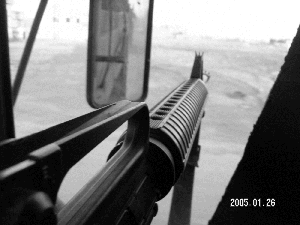
I am stuck outside the wire in the passenger seat of a 20-ton dump truck, and my weapon, an M16, hangs out of my window. Its selector switch is no longer on safe. I've switched it to semi. I switch it once more to burst.
Three-round burst. Three rounds in rapid succession. My lieutenant made sure we loaded our magazines so that every third bullet is a tracer. Think of those yellow streaks you see in Vietnam movies. If things are moving too fast to use the sights, we aim off the tracers.
Aim low.
With a three-round burst, your rifle will unavoidably kick upward along the front of the target. Aim low and you're bound to hit him once. If you're lucky, you'll land two. Only a ranger could sink all three.
We wait for direction. I watch my sector.
We sit on top of a foot and a half of gravel we've poured over the last week, and we are under our own firepower: Humvees mounted with 50 caliber machine guns and M60 machine guns and ammo box after ammo box and AT4 rocket launchers hanging off their turrets and, on our person, we have fragment grenades and smoke grenades and M16 semi-automatic rifles and Squad Automatic Weapons nicknamed SAWs for short. My lieutenant takes no chances when it comes to firepower. Not here. Not in the town that Achmed built.
I wait. Nothing in my sector.
A stray bullet whizzes by from somewhere. A high pitched whistle. It's missed any target it was intended for. I duck into my body armor like I could actually dodge a screaming bullet. It's a reflexive maneuver meant to keep me alive. It's a reflexive maneuver because I know our trucks are not armored. It's not in the Army's budget this year. We put half-ass armor on the doors ourselves while we were still in Kuwait. It's better than nothing, I suppose, but not really. Just more shrapnel.
Another bullet whistles by. I duck.
A metallic slap. Another bullet bounces off the dump ahead of me.
These are the bullets that fly from the road, that harbored the death, that drove the insurgents, who planted the bomb, that killed the people, who lay in the town that Achmed built.
Finally, some direction. The fighting has hit a crucial point: the eye of the storm. The lieutenant has a chance to initiate a plan. Over the radio, he tells the gun trucks to exit the convoy.
"Create a perimeter," he commands, "And give the dumps room to turn around. Over."
Three or four gun trucks pull out. One parks directly in front of me. I raise my rifle so as not to shoot the M60 gunner who's taken over my sector. The dump ahead of us moves, and my driver pulls a tentative foot off the brake.
The rapid gunfire continues.
"Stay behind the gunners," the lieutenant reminds the dump trucks.
The turreted Humvees sit on broken rubble. They can drive over anything. They sit fixed like a militant version of Stonehenge. We depend on them for protection. They depend on us to accomplish the mission. We are banded like cement binds rock.
We move inside the gate, and the gun trucks stay behind. A half a dozen tanks are waiting for the congestion to thin out. The last dump finds its way, and the tanks roll out, throwing dust in circular clouds behind them. They split and crusade down the city streets.
The gun trucks have done their job well and they return to the safety of the base. We hear explosions for another hour as the tanks avenge the ambush on their engineer friends.
Military Intelligence would later inform the lieutenant that the ambush didn't go quite as planned. The untrained insurgent who set the explosion off did so prematurely. He killed himself. His untrained insurgent friends were lined all up and down the street ready for holy victory. The trigger man was supposed to throw the switch on our first vehicle, thus trapping our cumbersome dump trucks on the narrow road. Instead, he spoiled the plan with a sweaty trigger finger, thus taking four Iraqi Army soldiers and seven civilians with him.
I hate to think of the consequences if the plan were carried out with success. We would have been stuck in the middle of downtown Samarra with crappy do-it-yourself armor. Insurgents would be feet from our vehicles sinking round after round into our weak-natured doors. Gun trucks would be utilized, but they would have no leverage. Not compared with men on their feet. The gunner can't aim straight down in front of him. The ambush would have taken many more infidels than it did.
My driver and I, our adrenaline rushes calming down, listen intently as the fifteen vehicles in the convoy call in their ACE reports to the lieutenant. An ACE report (Ammo, Casualties, Equipment) is a quick and easy way to estimate the standing of an entire element. Of course, we understand that if anyone took a casualty, we'd probably know about it by now. Still, we hardly breathe as the ACE reports come in.
They are done, and not the slightest casualty is reported. No casualties? How did that happen? It doesn't matter. We are alive.
We are soldiers and we are alive.
We are the soldiers who survive the ambush, that came from the bullets, that flew from the road, that harbored the death, that drove the insurgents, who planted the bomb, that killed the people, who lay in the town that Achmed built.
A lot of questions accompany war.
Was there a purpose for this loss of life? Was their loss my gain? Does my life hold a higher value? Do I pity their calamity or honor their sacrifice? Am I lucky to have survived or unlucky to have witnessed those who didn't? Does my life become troubled with guilt or meaningful in making true sacrifice worthwhile?
I will make purpose of this loss. I consider it my full responsibility to give purpose to myself, to my family, and to your freedom.
For the infidels.
© 2007 by Ryan Smithson.