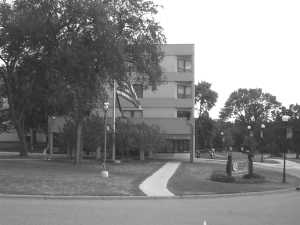
Sometimes my brother Doug is one of those guys leaning against the stone and brick VA hospital, just outside the lobby-a gargantuan space designed to honor gargantuan efforts. He's with the others who are too sick to be functioning much but just determined enough to drag themselves into this knot of smokers, this mixed bag of aging and frankly aged men. Hospital gowns and robes are dress uniform for those dancing with IV poles. T-shirts dominate, saying things like "Jail Sucks" on display next to those who "Race for the Cure" while the last of the WWII vets, age-speckled and surprised to still be alive, hide away inside running pants and zipped sweat shirts. Those who experienced the Korean Conflict, (who defines these things?-it can't be by body count) mark the age gap between the other two groups. None of them look anything like the soldiers they can't quit imagining themselves to be.
Too often now, he's inside instead. He could have had a new liver some years ago but declined, saying he could never afford to wear out a young organ. That's Doug, the funny one. He's the one now with the huge belly and the skinny legs. His hair is a rebellious sort of gray, long and full of wiry curl. Ma always said he had no business getting that thick curly hair while I had a limp, stringy ponytail. When she said it though, she was always running her hands over his head and smiling, as though she'd woven every strand as a gift for him. He has this crooked smile; it pulls to the left and makes his face lopsided. That came about when I chipped his front tooth with a well-aimed hairbrush one crabby, rainy day in the mid `50s. People didn't get teeth fixed back then if they could still chew, so he learned to smile around it. It only made him more adorable.
My name is Sheila and I have become, through family attrition and fifty-plus years of history, Next-of-Kin/Emergency Contact on the forms in Doug's world. Now, Doug's world is not chock full of forms to file. Those details dropped away, one by one, like all the ordinary annoyances of a mainstream life. But he did keep all the treasures he earned from exposure to Agent Orange: a forty-year rash and a VA benefit.
I'm here again. Or, he's here again. It varies the slightest bit with each admission but the theme is consistent. The medical residents who take care of him are all young and full of good intent. They learn that I am a nurse and they cut to the chase of medical shorthand to tell me the same story. Doug's liver is shot full of disease and is unlikely to do any of its many complex tasks very much longer. Can I convince Doug to quit drinking, they have asked? If I had such talent, I tell them, I'd have sought a career more lucrative than nursing-like, say, politics or real estate. They mean well.
The last time I was called here on this mission he looked ghastly. But there he was. I told him after looking him over for thirty seconds, "You look like shit."
He shrugged and said, "Who knew I'd still be alive?"
"I'm not convinced you are."
Then he smiled that dear sideways smile, and against all medical advice hauled his battered body out of the hospital, determined not to go to the Extended Care Center or to my couch, and tricked me into driving him and his worn-out duffle bag with all its pressed-together pile of his life's accumulated clutter, and dropping him off at his favorite pub. I pounded on the steering wheel and cursed at him, then rose up, nurse like, and said "Douglas"-our mother called him Douglas in those rare moments when she was not enthralled with him-"I will not watch you do this to yourself."
"Then just don't look." That's what he said. He scolded me to get going, that the neighborhood was full of assholes and losers and no place for me. Then he hauled that damn bag and that big, fluid-filled belly on those toothpick legs right into that stinking bar.
You're wondering why I came back. Not for an inheritance, to be sure. I'm back because my mother wasn't all wrong about his charm.
When he was responsible for taking care of me in the evening when Mom worked he would leave me alone and tell me not to cry, because he was going out for a candy bar for me. He would bring the candy precisely five minutes before Mom got home so he could throw me in bed and tell me to stop my damn sobbing, I had a candy bar, right?
I guess that wouldn't be points in his plus column, huh?
OK, the snow fort that he let me come into although it was clearly a No Girls Zone. I felt like some big deal in there! We hid behind the icy boulders, stacked and packed with heavily mittened hands, and we pummeled my teetering snowman with snowball ammunition. He never fired back with his stick arms. Doug and I went in for supper, victorious over winter.
His '57 Chev convertible was amazing. He'd come in during the wee hours and sleep through the morning. I would be out there pushing on the gas pedal and turning the wheel, earnestly believing I was driving along the California coast with a chiffon scarf whipping in an imaginary ocean breeze. I was Sandra Dee or Audrey Hepburn while he slept off last night's beer.
I owe him the five dollars that he loaned me to buy a record album by Lesley Gore in 1962. I still have the album somewhere. "It's my party and I'll cry if I want to..."
It got nasty though, when the war came. Forgive me; Vietnam was never a war, was it? Those definitions again. So there was Doug, one year from graduation at the University, the pride of a blue-collar family, when the arguments began. Our dad, a still proud vet of the Navy who served at Midway, grumbled and bared his teeth every night during the six o'clock news and lectured Doug, stabbing the air with his eating utensils to make his points, all through supper. He groused about war protestors and stinking commie brats until Doug threw up his hands and gave up his student deferment to enlist in the Marine Corps. It was a short run through California then Japan and soon enough he was showing Dad that he could fight a war, too. Letters were infrequent, and Mom cried every night while the news was on; it got pretty quiet around the house. When Dad died, Doug didn't come home. His message was clear; he was a soldier.
When he did come home, finally, Mom was giddy and I was just a sullen teenager glad to let her call her dogs off me for a while.
He didn't go back to college. I did. He got married, a couple of times. I didn't.
I won't discuss his taste in women, though you might find it entertaining. As a sister-in-law, I never did.
None of those wives or estranged children is here now to click clack over these marble floors and look for his shrinking body in this behemoth building. It keeps getting bigger and more cavernous as he gets smaller and less significant.
I know the halls of this place in the way all nurses can sniff their way through any hospital. The artwork and the gift shops may vary and depending upon the affiliations, the chapels or meditation rooms can take on some spin, but in the end there is a constant theme: rooms, beds, meds, lights and smells.
I find him again. I approach the bed and touch his hand. It's bruised from false starts for the IV. His veins are shot, no doubt. This time, he doesn't open his eyes and say, "Hey Shortcake. Who called you?" As if it was ever anyone else. His breath smells of mice and old sheds and his chest rattles with congestion. Perhaps it's time to counsel him about his smoking.
A nurse enters the room and tosses a heavy braid over her shoulder. Her pockets are stuffed with her tools and her step is still brisk. I could warn her-after twenty years or so of lifting and rolling these guys, her pace will slow a bit.
"Ah, you're here. Dr. Simon wants to talk to you. I'll page him."
"Is he going to tell me about Doug's liver failure? Really, he can skip that and keep doing whatever he's doing."
But she is out the door. I open the drapes and let the sun spotlight Doug in the bed. His brow wrinkles in response to the light but he still doesn't open his eyes.
"Dougie. You look shittier than before. How can that be?"
No response.
"I should wash this hair of yours. No running water at the bar where you live, guy?"
I run my hand through his snarled gray mane until a middle-aged man enters the room.
"Dr. Simon. You must be Sheila."
"You must be a real doctor. No residents on Wednesdays?"
He smiles, that old kindly Dr. Kildare smile that I only ever see on television. I know it's a bad sign.
So, we talk about hepatic coma and deteriorating chemistries and diminishing odds and how Buddy's Tavern will have to get by without its best customer.
When he leaves the room, patting my shoulder in a fatherly gesture, I sit next to the bed and lower the side rail- another basic nursing skill. I lay my head on Doug's shoulder until the grating in his chest becomes too hard to listen to. I sit up and take his hand.
"Doug, do you remember the summer you built a cage out of nailed-together screens that you dragged out of the garage rafters?
"I know, you aren't talking to me anymore so just listen." I pull the chair closer to the bed and change personae from nurse to first grade teacher at story time.
"Well, then you went to the school roof and caught a bat and kept it in that cage. I felt bad for it and tried to feed it lettuce. Did you know that bats don't eat lettuce? I didn't then either."
Doug moves his leg under the sheet and it looks like a sharp object rising up from the mattress. I wait to see if he is waking up. Maybe Dr. Simon will be surprised one more time in his career. But, no, maybe not. It is no more than a weak effort and soon he is inert again.
I continue my monologue. "You lost interest in the bat, I think you went off to camp or something. I came out one summer morning and it had chewed its way out of a corner of the screen and was walking," I pause because the image remains so grotesque, "walking, like on its shoulders or whatever those would be on a bat, down the sidewalk."
What do I expect? That Doug will rise up and say, "It was just a damn bat, let go of it already and get my cigarettes."
"It was gross and it scared me. I was scared of that bat all summer."
I stand up and pull up the side rail. There is little danger that he'll fall out of bed but it is standard practice.
"So Dougie, I do believe you've chewed the corner of your cage out now. I wish I could help you fly."
© 2007 by Beadrin Youngdahl.