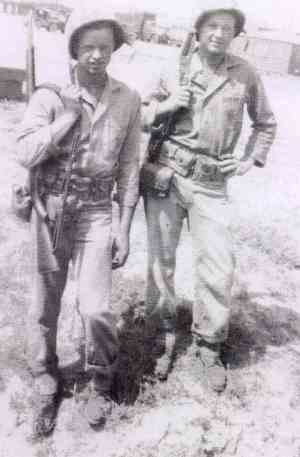
LP duty. Listening post duty, that is. This was Korea, November 1951, in the Black Diamond Mountains above the 38th Parallel near the Eastern seacoast. I was the scout sergeant of a forward observer team. Unfortunately, my actual rank was only corporal, and that meant I shared all front-line duties with the infantry men that we were attached to, the 2nd Battalion of the 5th Marines.
Just after dusk, while we could still just see our way, Baker and I took our rifles, sleeping bags, and a canvas sack of grenades, and crept down the forward slope of the steep ridge. We didn't speak. It was going to be a long night.
Fifty yards down the steep hillside we came to a small bunker scraped out of the hillside. There was a low parapet of large rocks, perhaps a foot high, and a leveled spot where the man not on watch could stretch out and sleep. It would be two hours on, two hours off all night.
We stopped and listened and tried to see through the deep twilight. Had we been seen in the dim light coming down from the lines? Were, even now, men in padded uniforms, wearing rubber soled pad-sided shoes, a small red star on the front of their caps-were they even now grouping into a small patrol to quietly slip up the hill from the river valley below, and take us? To our left, not quite a hundred yards away, was another listening post manned by marines like us. To our right was a steep, deep ravine, probably not negotiable in the dark.
Two nights ago, A Company had lost two men on LP duty-one dead, one wounded. The North Koreans had thrown a concussion grenade at their position, had rushed up, killed one marine but couldn't find the other unconscious in a heap in the dark, seized their sleeping bags and left. In the cold Korean winter, those feather-filled, GI sleeping bags were coveted by an enemy that suffered from lack of equipment.
"Let's wait here till pitch dark, then move over there," I whispered to Baker, pointing to a small depression in the hillside perhaps twenty yards to our right and a few yards down. Baker nodded, his eyes big in the near dark.
A half hour later, with our teeth starting to chatter from the cold, we crept to the new position. We quietly moved some rocks, smoothing out a sleeping spot. I was wide-eyed. "Want me to take the first watch?" I whispered.
"Yeah," Baker whispered back. He crawled into his sleeping bag, the scrape of his clothes as he did so sounding like alarm bells in my ears. The scratches and scrapes of his movements seemed to shout to the enemy, "We're over here now! Come get us!"
I found a low rock to lean back against, opened my sleeping bag and sat on it, pulling it around my shoulders. My M1 rifle I held in my lap, the stock tucked away under my right arm in the sleeping bag. With my left hand I carefully set three grenades in a row on the ground beside me, set there where I could quickly find them in the dark.
I deliberately breathed loud, slow breaths, composing myself, trying to get a mind-set for the situation. I adjusted the ear flaps on my cap under my helmet so they just covered the top tips of my ears. I stopped moving my head from side to side to see, just rolled my eyes to the sides instead. Gradually my senses sharpened, tuned in. I tried to smell the tingle of danger in the air. I was ready.
In front of me was a steep valley with a river running the length of it from left to right. This I knew from what I had seen in daylight and from my study of the maps that we used in our observations. Beyond the valley was a beginning range of rugged mountain peaks. The sky above those mountains was lightening. In an hour, the moon would be up. That would help. It would aid those who remained still, quiet, motionless. It would show moving shadows of those who moved in the night.
Behind me, up the slope, fifty-some yards away, I could hear the occasional scrape sounds of people moving, quiet thumps as someone stumbled in the dark. For a short time I could hear the hissing static of a radio transmitter cutting off and on as someone checked in with the battalion headquarters. I could hear the rustle of Baker breathing as he slept. Why did he have to breathe so loud?
I smelled it first. Smelled it on the warmer air rising from the river below, rising up the slope towards me. Cooked cabbage smell. Dried fishheads smell. No sounds. No shadows. Just the smell of danger wafting up the dark slope.
I put my hand out to touch Baker's sleeping bag. But what if he spoke or grunted as he woke up? I took my hand away.
I put my thumb on the safety of my rifle, trying to ease it forward inside the trigger guard so that it would not click. I strained my eyes and ears forward in the darkness. Nothing.
Nothing ... then softly, the brief scrape of fabric against bush. Now I had a direction. It was as if a cone of my full senses concentrated on one spot down the slope. Was that a shadow of a form, or just a dark bush? Again a sound-the faint sound of a foot grating on dirt and rock. I began to ease my rifle forward. Hurry, moon, I thought. Give me some light.
Finally this war was personal, very personal. The previous afternoon I had directed a fire mission of artillery against a bridge over the side stream that ran into the river below. That had been fun. Blowing up a bridge. This was not exactly fun, but it was very intense. I had never been so alive.
Far off to my left, where the river and valley curved away, I saw the bright, momentary muzzle flash of rifles firing, and the thin red pencil-lines of tracer bullets fired from machine guns. Several seconds later I heard the sounds. I thought, I'm not going to fire my rifle and give away my position. They probably think we are still in that first position. Soundlessly I shrugged the sleeping bag, and lay down the rifle. I picked up one of the hand grenades.
All was silent down the slope of hill. Had they gone? Had they come closer? I didn't think so. I now believed that my senses were so keen I could have heard a worm crawling on the ground.
Would a dozen of them suddenly leap to their feet and come charging up the hillside, screaming, firing their rapid fire burp guns? They would be on me before I could stop them all. Now was the time for action. I had the grenade, spoon under my palm in my right hand, and pulled the pin with my left middle finger. I was committed.
Here it goes! I threw the grenade in a sweeping, arching motion, heard the spoon pop off and tinkle to the ground. I crouched low as I could, helmet brim now on the rocks in front of me.
Karomph!
I felt the hammer-thud of the explosion on the ground on which I was kneeling. I heard the snick of shrapnel slicing through brush and twigs. The sound of the explosion went across the valley and was echoed back to me.
There was silence-a long silence. I peered out from under my steel helmet, pulled down almost over my eyes. My right hand was on my rifle.
"Huh," said Baker from his sleeping bag.
"Ssshhh," I whispered. I waited. There were no sounds from below.
I waited and waited, and finally pulled my sleeping bag over my shoulders as I sat there, to keep warm. I waited some more.
Finally, slowly, the moon, big and round, almost a white-yellow, slipped silently from behind the black, rugged peaks across the valley. Now there was light.
A dense, white mist was rising off the river at the bottom of the valley, rolling up and building, seeming to fill the valley. Up the slopes this moon-bright whiteness came till it was almost at my feet-a sea of soothing softness that stretched across the valley to the dark mountains a thousand yards away. The night was turned into light. My world had become something calm, peaceful and serene.
In that dream-world, I was no longer at war with anyone. I was not on some forward outpost, rifle and grenade ready to trigger off some loud violence. I was only some quiet, introspective individual in awe of a night that had begun as a time of long, drawn-out fear, and had turned into a thing of beauty and wonder.
In the morning we went down the slope to where my grenade had landed. We could find nothing. No sign of anyone ever having been there-and the incident had almost been erased from my memory.
But an evening ago, fifty years later, I stepped outside and in the twilight walked the snow-covered ground to the overlook of the lake. I leaned against a dark tree trunk and looked across the white lake, covered by ice and snow. There was a faint foggy mist rising off the lake, and across the lake, the moon was just rising.
I closed my eyes, and I was back in my past-in Korea.
© 2007 by Clifford Schroeder.