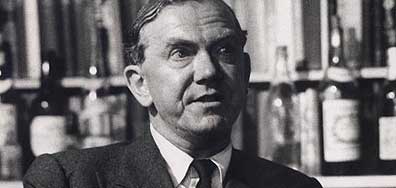
Few writers from the recent past combined great literary acclaim with such wide popularity as did Graham Greene. All told, his works sold over twenty million copies, and most of his novels are still in print and widely read twenty years after his last published work. This despite main characters created by a writer of whom V.S Pritchett said "rarely transcends his perverse and morbid tendencies." Brighton Rock, The Power and the Glory, The Heart of the Matter, The End of the Affair, The Quiet American, A Burnt-Out Case, The Honorary Consul, novels that would earn nearly unanimous critical acclaim, all portray major characters dogged by Weltschmerz, alienation, cynicism and despair-and everyone of them became a bestseller. Greene loved paradox, the darker the better. Scobie, the kind, compassionate hero of Heart of the Matter, ultimately kills himself out of pity for his wife and mistress. Eduardo Pharr in the Honorary Consul dies supporting a political struggle he does not believe in. Readers came to love it, keeping such books on the bestseller lists for months.
Greene was born in Berkhamsted, Hertfordshire, England in 1904 and died in 1991 in Vevey, Switzerland in the company Yvonne Cloetta, the favorite and longest lasting of his several mistresses. He was the fourth of six children of an affluent family that in an earlier generation had made its money in brewing. His mother was a first cousin of Robert Louis Stevenson and his father the headmaster of the same prep school where Greene was sent to study. His experience there at the hands of brutal classmates led to several suicide attempts that, according to Greene's own account, left him psychologically scarred for life. He wrote his first novel at the age of twenty-two, but it was not until his third novel, The Man Within, that he got one published. His first paid work was as a journalist, not a novelist, and he would continue to keep his hand in that media throughout his career, publishing all told some 500 reviews and criticisms. Early in his career he brought out his own literary magazine, Night and Day, and was sued for libel when he printed a review of the Shirley Temple film, Wee Winnie Winkie, saying of the nine-year-old Miss Temple, "Her admirers-middle-aged men and clergymen-respond to her dubious coquetry, to the sight of her well-shaped and desirable little body, packed with enormous vitality...." Greene lost the case and the journal folded. In 1932 he published Stamboul Train-Orient Express in US editions, his fourth novel that he consciously set out to write cinematically, and badly, hoping that the movies would pick it up. They did but only after the book had become a commercial success in its own right. Best selling book to successful movie, Greene's name was made. He would go on to write some fifty or sixty works-the figure varies-including at least twenty-four novels (several unsuccessful) in two categories, those he termed `serious novels' and others called `entertainments,' four plays and several movie scripts, of which The Third Man became the classic of which all later film noir thrillers were derivative. Greene later wrote a novella based on the movie. Add to this numerous short stories and essays-well, one can see why accounts of Greene's prolific output do not always agree.1
Greene's first great critical success came in 1938 with Brighton Rock, his first plunge into the quagmire of moral ambiguity, a subject that would become the inspiration for his major works. His challenge was to make such material engaging. One of Greene's favorite techniques was to drop in on a man-all his major characters are male- run aground in some tropical Third World backwater where he wrestles with profound moral problems. If a writer is intent on being a serious moralist, he must, if he means to sell, be a stylist of note and a master storyteller as well. No writer of the twentieth century surpassed Greene in his mastery of character, event and scene. He seeds his prose, a language as transparent as distilled water, with metaphor so apt, so original the reader pauses to reflect. Greene was a lifelong undercover spy for the British government, and he would put his familiarity with the workings of counter intelligence to work in his novels by lacing them with intrigue, mystery and suspense. His plots never fail.
Much has been said of Greene's Catholicism, perhaps too much. One critic, for Time magazine if memory serves, said of Greene: To read him you need hold the novel in one hand and the Summa Theologica in the other. Most critics were not quite so carping, but hardly a review was written without mentioning Greene's preoccupation with Catholic moral principles. Greene converted to Catholicism at the age of twenty-six, but attention to Greene's religion did not become widespread until the publication, in 1941, of The Power and the Glory, a work dealing with a whiskey priest during the Mexican government's vicious persecution of Catholicism. The book was much too good to ignore-many still consider it Greene's greatest work-leaving the critics, mostly secular, with a moral conundrum of their own: How to review a novel grounded on such explicit moral and religious principles while possessing such undeniably glorious literary merit? The Pope knew how and he promptly condemned it. The readers were troubled by neither a censoring Pope nor secular critics and kept the book on the bestseller list for months.
The readers were right of course in ignoring Greene's Catholicism, the better to enjoy his books. Greene himself did much the same. Married at twenty-three to the woman responsible for his conversion, he was visiting prostitutes two years later, a pastime that he would pursue at great expense of time and money for most of his life, totting up, according to his own tally and discounting his several mistresses, forty-seven in all. (That he should have kept count.) Greene's personal life and public pronouncements demonstrate that he was never seriously committed to his religion. In the Forties and Fifties, Catholicism was trendy. Thomas Merton's Seven Story Mountain, which tells of the Trappist monk's conversion to Catholicism, sold upwards of 1,600,000 copies (and is still in print today). But unlike writers such as Merton and Dorothy Day, another noted contemporary of Greene and like him a convert to Catholicism, the baptismal water didn't take. For Greene, Catholicism became largely a romantic and intellectual interest, a system of thought put to work doing the heavy lifting in his novels. He found his métier with Brighton Rock, his sixth novel, and realizing he had hit upon a good thing went on to structure four of his seven or eight best books on Catholic moral principles. If further evidence of Greene's lack of religious convictions is needed beyond his impious personal life,2 we need only turn to his public statements. "I've always found it difficult to believe in God," he said at one point, and went on to call himself a "Catholic atheist." Whatever that is: Greene loved paradox.
He used Catholicism as he did his experience with the cloak and dagger world, as a source of concepts and moral icons to give body to his stories of good and evil (mostly evil) in an age that was losing its ability to distinguish the difference. Greene's purpose in all his great novels and in many of his entertainments was to probe deep into the mental, moral and emotional depths of his characters. No one has done it better.
With the publication of The Quiet American, and especially in the creation of Eduardo Pharr, the protagonist of The Honorary Consul, Greene set Catholic moralizing aside in pursuit of humanism. His heroes are still plagued by moral ambiguity, cynicism, alienation and despair (who among modern men are not) but their dilemma is now expressed more in humanistic terms rather than theological. The church is still there but now mostly as the crumbling cathedral on the square, not the omnipresent rack on which Greene tortured the soul of his morally troubled characters. In these later works, in place of moral principles, political chaos now provides the backdrop of the Third World settings for his novels. From page one of these later books the reader is still aware of evil hovering on the horizon, but defined now as corrupt local governments and the nefarious political machinations of world powers, with the United States coming in for particularly harsh treatment.
Greene has sometimes been accused of being anti-American, even a Communist sympathizer, citing The Quiet American as evidence, an opinion that can only be supported if we ignore what we now know of the bumbling behavior of the CIA, which figures heavily in the novel. But there is no doubt that Greene, when he turned to writing political novels, did not take kindly to American imperialism. Which is offensive in that he did not chastise British imperialism, neither in his autobiographical works where he speaks at length of his travels in British colonies, or in novels like Heart of the Matter and Honorary Consul whose settings gave him opportunity to address the issue. In these works British imperialism is a silent, sometimes humorous presence but not a force to be decried as Greene overtly does in his assessment of American imperial ambitions. Another Greene paradox: even after Kim Philby, the famous British double agent, fled to Moscow, Greene, a lifelong leftist, continued their friendship. Yet when it came to Britain's image in the world, feeling for country won out over political idealism and he could not bring himself to hold Britain's feet to the fire. One wishes that at some point, if only to balance the score, Greene would have turned his interest in great power meddling to England's bloody conquest of Ireland and India, or any of the several African countries he knew first hand and that were, in his day, still under the British Lion's paw. But nary a word.
Humor is not a strong suit in Greene's serious novels in that he rarely creates a scene for comic relief. His wit and humor more often appear in metaphor. Image after image, the reader is swept along on a flood of imagery, often perverse, yet right on. In A Burnt-out Case, set in a leprosarium deep in the heart of Africa, "...A baby began to cry and immediately like dogs all the babies around the dispensary started to howl together." And in Brighton Rock, "She loved him...but love was not an eternal thing like hatred and distrust" and, "...Coming down the stairs to Rose [she] fastened a mouth wet and prehensile, like a sea anemone, upon her cheek." And the jokes: "Sometimes I think God was not entirely serious when he gave man the sexual instinct. ... Nor when he invented moral theology." Greene's personal-public life shows a sense of humor more often ironic but less acerbic than in his writing. He was so widely read that the turf he cultivated became known as "Greeneland", a term which amused him as much as his critics. On two occasions he entered, pseudonymously, contests parodying his own works and style. He won neither but took a second in one and an honorable mention in the other.
In 1959 the Bolshoi Ballet came to New York for their first appearance in America. Andrea Espé, a dancer with the Ballet Russe de Monte Carlo, went to see the Russians-and promptly retired from her company. Asked why she said, "If I can't dance as good as the Russians, I don't want to dance." Reading Greene can be like that, there's hazard in it. The reader may find novels to follow disappointing; writers may compare their work to Greene's and ask, Why try? 3
Comb today's lists as we might, we will be hard put to come up with a character matching the depth of any of several of Greene's-the killer Pinkie, the whiskey priest, the policeman Scobie, the writer Bendrix, burnt-out Querry , doctor Eduardo Pharr. Coetzee came close with David Lurie, the morally conflicted professor in his stark Booker Prize novel, Disgrace, but while Coetzee approaches Greene's skill in plumbing the soul of his character, he lacks Greene's superb command of plot. Greene could build plot from material as esoteric as the ambiguities of Right and Wrong versus the dogmatic certainties of Good and Evil.
Looking into novels recently published to loud literary acclaim, too often we find small characters leading very private lives whose reflections, when they reflect at all, do not go much beyond the banal detail of their domesticated lives. Gone is the excruciating soul searching of Greene's fatally flawed characters whose thoughts reliably transcend the circumstance of their disappointing lives. Gone is the engaging situation, the intrigue, the corruption, the treacherous rogues often as ultimately sympathetic as the central character. Gone in fact is what makes a novel worth reading, and we are left with the modest hope that we will find literary pleasure in lives scarcely different than our own, in the prospects and accomplishments of our lovely children, in the joys of matrimonial sex with our much loved bed partner of the past twenty years. Flaubert, Tolstoy-and you too Graham Greene-all masters of the novel of adultery, betrayal and despair, do come back. We miss you.
© 2007 by Hugh Mahoney.