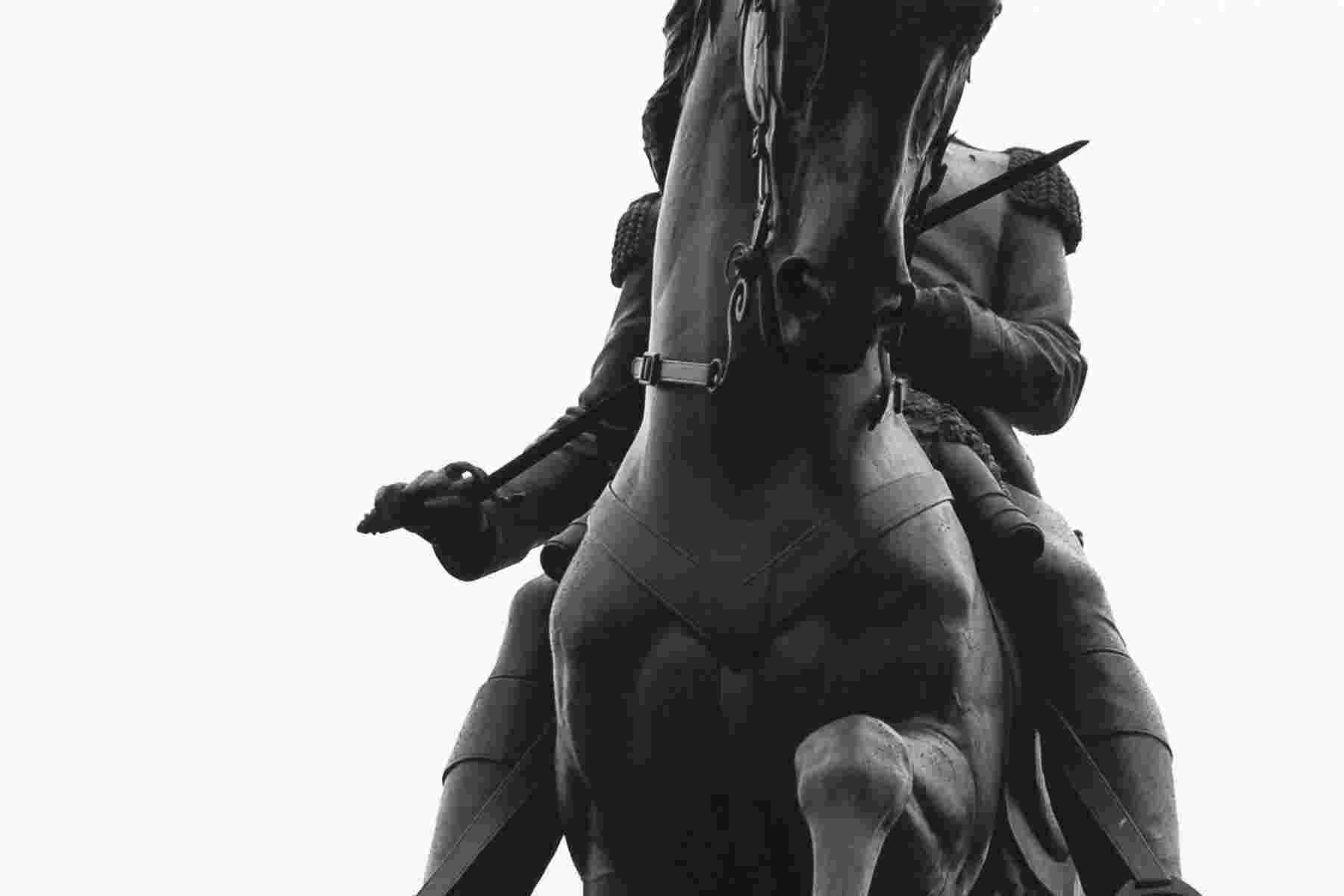
Though not an ugly man, the Colonel was more embarrassed than humbled by his own nudity. "The measure of a man indeed should be his ability to command a thousand men whilst he himself stands stark naked." Or so he confided sheepishly to a half-deaf mistress on the eve of his greatest military triumph. He stood behind a corset and petticoat-strewn dressing partition, barely a man at all-"But Colonel," the woman who had by then made love to this man thirty-one times still called him only `Colonel', or `Sir'-"you are a beautiful man. Why, Xerxes himself was not more beautiful than you when he led his naked Spartans against those dreadful Persians." She came to him, her eyes now dutifully closed, and with a finger to the chin brought him coldly to her unmade bed. "Men are not beautiful," the Colonel kissed his mistress out of habit, on her good ear, an ear he had once marked with his teeth so as to remember quickly into which ear he should properly confess, and into which ear he should practice his terrible poetry. He smiled bitterly to himself at the fair-natured woman's historical mistake. Her `faux pas', he hated when he found himself thinking in French, and he smiled the bitter smile of a teacher who has failed-"Oh Colonel," the aging young lady now laughed more than she giggled, but always at words she could not hear. She pulled the most dangerous man in the new colonial republic close to herself-"Oh, Colonel, you are a funny man."
Her breast pressed against his, and indeed, the Colonel found himself thinking more and more to himself of late, and especially, if not always, within these fewer and fewer bouts of lovemaking, `I am a funny man-'
`The General died at dawn.'
`The General died at dusk.'
`The General died at high noon.'
`The General died at midnight.'
`The General died at 10:37 in the morning.'
Too often he thought of the last word as it would appear in print. And always he thought of himself as General of the Republic. Surely he had earned the promotion, and when is the most glorious time to die? Is there an exact hour, moment, second? Does it matter that God loves a great man more than all the others? The Colonel thought of these things frequently, and with great shame. "A man's glory will have been established on this earth long before his last breath escape." These were the words of his storied father, decorated veteran of the Indian wars, with whose words the Colonel took vehement issue. He had seen too many ordinary men die gloriously, grabbing an entire lifetime's draught in their last breath.
`The Colonel lived forever.'
That thought scared him most of all.
"Colonel!" One of his lesser-trusted aides came up at a fast gallop. "The rebels are crossing the river!"
The Colonel and his dragoons had been marching toward the river in anticipation of a fight. More than a week had passed since they had heard the distinctive reports of homemade rebel guns, weapons like as not to be more fatal to those standing behind as in front of their poorly hollowed barrels. Still, the war was as yet young, and the rebels were not yet wearied of their cause. And though thus far two rebels had died for every one of the King's soldiers, the passion and the fervor for some ill-defined independence fed well the hungry mouths of this strange new land. More than once the Colonel had practiced the thought, `Were I not a soldier sworn to King and Country, I should be the very soul of this bloody rebellion.' Indeed, he often caught himself saying this aloud, as if practicing for his own trial, for his own defense against the otherwise unthinkable charge of treason for which the increasingly unbalanced King sought so zealously to prosecute millions. A righteous rebellion; the Colonel did not quibble with the logic of the instigators. He in fact empathized with the intellectuals behind the movement. An educated man himself, the American-born Colonel had attended school in England with Sir Edmund Burke. The two had remained friends since, and they corresponded not infrequently. In these letters they spoke to each other of the war as if one side were Troy and the other were the Aecheans-
"Aye," the Colonel answered his aide with his favorite low-caste word, a word he had picked up either onboard ship during his many crossings of the Atlantic, or else in the colonies themselves, where all the men and women spoke like sailors-"I can hear their footsteps plain enough. As I am sure they have heard yours, Captain."
"Sir-"
"Bring your men 'round, dragoon. To my right. And quickly, damn you. We shall have the river do our bloody work for us."
And so the Colonel led his dragoons at full gallop toward the low-boiling Delaware River. A great red eagle, so the coated British regiment appeared, as its flanks spread like wings, thinly to either side of the Colonel's lead battalion. A show meant more to terrify than to further any strategic aims, and the Colonel could not help but be sporting to his rebel counterparts. That is, he thought it rather more just than fair to leave them with hard lessons after each encounter, to educate them, in a way, but in a meaningful way. This was a country that would one day be free after all, whether that day be tomorrow, or one hundred years from tomorrow. This was a country that would one day, too, bear the legacy of the Crown, and it, too, would one day have need of men of worth. Men tried in battle, that is, and the Colonel was always careful to spare as many enemy officers as possible. In this case he meant to scare the rebels with a show of might greater than was in fact there. Lines one and two deep rather than five and six, but to those men looking back in a hurry over their shoulders the lines may well have been a dozen deep.
The rebel lines broke at once at the first sight of the fearsomely crimson and mounted dragoons. The Colonel gave the order to charge. Madly did the rebels scramble over one another, half-swimming, half-drowning, and fully half their number were carried downstream. Dead or not they would eventually be picked over by Algonquin women searching for boots, hair, and teeth. Six shots were fired by the dragoons before the Colonel commanded a cease-fire. He pulled his men up at the banks of the swirling river, and they held parade formation there in a great red and black wall that may well have marked the very front line of empire. The very flesh and blood incarnation of royal decree, and all the King's men sat upright in their saddles. Swords raised, muskets down, to a man they stared placidly at the dozens of rebels floundering before them like children. On the far side of the river those rebels who had managed to escape the water took panicked aim at the hated redcoats as if taking aim at the side of a barn. But their ill-formed and too heavy musket rounds splashed like stones halfway across the river.
"Sir," the Captain of the Guard spoke up like Caesar's own Master of the Horse, through gritted teeth and nearly sealed lips, "what of the rebels on the other side?"
"There are no more rebels on the other side, Captain. They will return to their farms and wives soon enough."
The Colonel had his men keep formation until the very last rebel had either run away or drowned.
`The General died in his bed.'
`The General died in the saddle.'
`The General died in his tent.'
`The General died in the arms of his mistress.'
`The General died in 1782.'
Would that be the last word? The `where' versus the `when'? And where indeed is the most fitting place to die? In battle? The Colonel had heard the constant refrains, sure, since he first read Homer and Vergil. But battle is both a time and a place, and a man can just as well trip and fall on his sword as be properly bested in a fair and honorable fight. The Colonel had seen men die of heart failure in the midst of battle; he had seen exhausted men fall asleep whilst their steeds were in the midst of charge. Run through easily by rebel swords and lances, and is it more proper to say that these men died in their sleep, or that they died in battle?
`The General died today, and with him all war ended.'
So every soldier's obituary should read, thought the Colonel with a grim smile-
The Colonel's favorite mistress resided in Boston. He had a wife and children proper, to be sure, and these resided properly in London. They had never made the trip to the colonies, not even to see his sister-in-law, who lived, as she put it in all her letters, in New England. This in-law, however, was unmarried at the age of thirty and, known to wear pants even, was little spoken of by her grievously noble British progenitors. Hers was but a meager attempt, in any case, at drumming up resolve within the concave breast of her too delicate sister, a woman who had nearly died of exhaustion on a two week-long tour of her own family's vineyard estates in Austria and France. `Weak constitution' was how the King's surgeon had described the perpetually frail woman's condition. `Consumptive' was how the Colonel chose to describe it. He knew his wife was dying, had known it for the past few years, years in which he had seen the woman twice. He waited patiently for news of her passing. Truth be told, he loved the wild lands of the colonies far more than he ever loved his wife or their two daughters, not least for the bit of wild these lands seemed to impart upon their American-born ladies. `Perhaps if I had had a son...' he thought on languid occasion. But no. Had he had a son he would have hated his wife-
Before the war the Colonel had purchased several hundred acres just west of Boston. Wooded, lively lands, too, these were, and he had no illusion of himself as farmer. He had bought the lands that he might hunt at his leisure from his own front door. Likewise, he had no illusion of his wife surviving an Atlantic voyage to join him. They had always liked each other well enough, but he had no intention of retiring to the trash-ridden streets of an achingly sprawling London for which he had never cared even in his school days. He had no desire to be that close to the King, and as he mentioned quite often in his letters to Sir Edmund, the Colonel was, at heart, as American as any rebel. "Thou art the worst kind of traitor," Sir Edmund wrote most recently to his friend, "a man who would betray his own soul."
And still, as he shed even his Boston mistress in favor of a tavern bunk, no news of his wife's passing.
Dear Sir Edmund,
They are calling your dear King George the antichrist now here in the colonies. This offends me. Not as an Englishman, nor as a Christian, but as a man of intellect. A dozen other men at least are more worthy of the title, and I wonder what the pope would have to say about this. The Vatican will surely have to update its records. I believe Elizabeth's father, Henry, was the last British antichrist. Aye, Edmund, we are all the Devil's children out here, and I wonder little at the both rampant fear and practice of witchcraft in these untamed parts.
But tell our dear King not to worry. Some of his most mediocre men are working diligently to solve this problem of bad press. And none too soon. Why, an entire generation of American-born subjects already honestly believes the King has horns sprouting goatishly from beneath his peruke. I've no doubt that should his majesty make but a single trip over to the colonies, and stand before these millions of his subjects whom he has never dared set eyes upon, all whilst wearing a red tail and declaiming the evils of empire with a raised pitchfork, this rebellion would end at once with these superstitious American fools groveling at the madman's hooves.
Farewell, Edmund. Speak your piece in Parliament, if you must, and if you see my wife, tell her I am well.
Walter
"Sit down, Colonel."
The Colonel sat dutifully, rigidly. He could barely stomach orders from the King. Orders from Generals, even as innocuous as a command to `sit', had him grinding his teeth once more. He used to grind his teeth as a child, till his father threatened to have him fitted for a horse bit-
"Colonel Durand," the General spoke the French name in typically British fashion, something like `D'rant'. This irked the Colonel as well-"Colonel Durand, how long have you been a Colonel in the King's Dragoons?"
"Eight years, sir." The Colonel had picked up the colonial habit, rather like a Welsh and Irish habit, of annunciating his final `r's'.
"Indeed, Colonel, do you think it fitting that a knight pass eight distinguished years in the service of the Crown without promotion?" The General sat behind a plain, boxwood desk. His headquarters was a confiscated schoolhouse in the colonial village of Brockton, about ten miles southwest of Boston. He looked about as home in these simple surroundings as a military uniform did about his slight frame. The Colonel hated those men especially who entered the military as Generals-
"It is what it is, sir." The Colonel found it an effort to speak with this man. Indeed, though the Colonel could ride for a day, fight through the night, and ride on another day without the least bit of fatigue, five minutes of sitting with a superior officer wore him to exhaustion. He stifled a yawn-
"It is at that, Colonel." The General raised a porcelain cup to his powdered lips. He had not offered the Colonel tea, and that was irksome, too. The two were alone in the room-"I have a proposition for you, Colonel," he replaced the cup to its saucer with a dull clank.
As if on cue a large African, ridiculous in knee-britches, lace, and powdered peruke, entered. With a stiff bow he removed the tea and walked backwards from the room. Neither General nor Colonel said anything for a moment. The silence was more awkward for the General, the Colonel knew. He sat rigidly still-
"As I was saying, Captain-"
"Colonel," the Colonel interrupted.
"Excuse me?" the General blinked. He was about ten years younger than the Colonel-
"You called me `Captain', sir. I am a Colonel. Please, forgive the interruption."
"Yes, quite," the General glanced sideways as if he might have heard something-"Anyway, Colonel, I believe I was saying that I have a proposition for you."
"Yes, sir."
"What do you think of the idea," he crossed his legs, "of pressing into service the natives?"
"I thought we were fighting them, sir."
"Not the colonials, Colonel. I am talking of the Indians."
"I'd take a colonial over an Indian any day, sir."
"But the Indians know the terrain, Colonel."
"Yes, sir, as do the colonials, and as do any of his Majesty's loyal subjects who has spent a year and a day outside the cities. The Indians offer us no advantage, General, except perhaps as scouts. And even at that they are unreliable. I'd sooner put rifles in the hands of the Blacks, sir."
"I see." The General tapped his fingers loudly upon the desktop, and pressed his thin white lips together so tightly they were nearly invisible. "Other of my inferior officers have told me quite the opposite, Colonel. They have told me that the Indians are fierce warriors, that their peculiar practices on the battlefield tend to strike terror into the hearts of their enemies. Is this true?"
"Perhaps in the hearts of ill-disciplined soldiers, sir. It has been my lengthy experience that the Indians are no more than screaming, murderous thugs. A well-disciplined regiment will always cut them to pieces. I believe the General would be wasting his time if he believes otherwise."
"Be that as it may, Colonel, I am assigning you to the task. Good day."
The Colonel looked over the nearly naked group of native `volunteers'. There were six of them in this inaugural class. With their hairless torsos, their smeared-on layers of animal fat as tunics, and their obscenely long, elaborately woven hair, the Colonel supposed these warriors were in fact more akin to the fabled Lacedaemonians who defended Thermopylae than were any wool-coated, pasty-fleshed British officers.
But, too, he supposed, war was different these days. For one, kings no longer fought. Thank God for that. But more importantly, three hundred muskets would have been more than sufficient to overwhelm the three hundred Spartans who held the fabled Greek mountain pass. And besides, thought the Colonel coldly, at the end of the day, it was the Persians with their superior numbers who held the pass in any case.
"Dragoon!" He shouted at his sergeant-at-arms, the man who had rounded up these volunteers.
"Suh, aye, suh!" It sounded almost like `sorry, sir-'
"Dragoon," the Colonel had an idea, "get these men fitted for proper uniforms."
"Suh?"
"Clean them up and dress them, Sergeant. Have them meet me for tea at three o'clock. I shall be in my office."
"Suh, aye, suh!"
"Keep your apologies to yourself, Sergeant."
"Suh?"
Indeed. The war was yet young...
© 2008 by Elliott Fuxon.